The Association of Stress And Immune System
All SpecialityPage Navigation
ABSTRACT
Within the last few decades, various studies have been conducted which show that stress is known to impact the immune system of the body by increasing the risk of various inflammatory disorders; including infections and cancer.
Older studies show that stress decreases one’s immunity. However, newer studies point towards a subtly different vision, that is, the effect of stress is bidirectional on the immune system, depending on the duration of its impact and the individual’s perception thereof.
Acute stress can have an enhancing effect on some parameters of the immune system in contrast to chronic stress, particularly depression, which downregulates it. However, this is largely determined by an individual’s ability of dealing with stress.
INTRODUCTION
Psychoneuroimmunology is a study of how psychiatric health impacts the human immune system. Within the last 2 decades, 3 large meta analyses have shown that cellular and humoral immunity are dysfunctional in patients with major depression.
• Herbert and Cohen (1993) and Zorilla et al (2001) both have demonstrated decreased T cell function and decreased natural killer (NK) cell activity in depressed patients.
• Dowlati et al (2010) demonstrated that interleukins (mainly IL-6) and tumor necrosis factor (TNF) were significantly increased in depressed patients.
Any event that exceeds an individual’s ability to cope resulting in an allostatic overload is a stressor.
The two major stress signalling pathways contributing to the dysregulation of immune system are Hypothalamic-pituitary-adrenal (HPA) axis and Autonomic nervous system (ANS).
PATHOPHYSIOLOGY –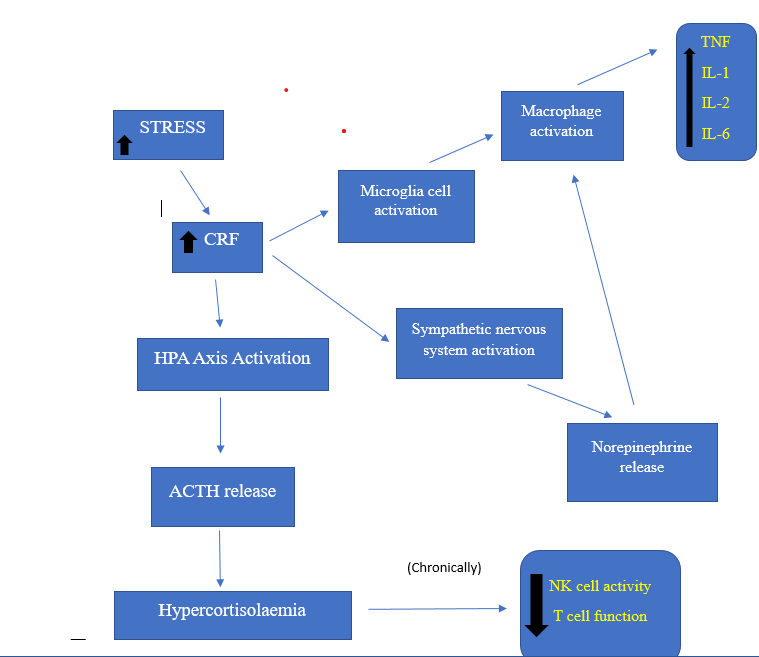
LINKING STRESS TO CVD –
Chronic inflammation secondary to long term stress plays a role in increasing the chances of developing CVD via early onset and progression of atherosclerosis.
Researches over the last half century have linked psychosocial factors and stress to increased incidence of CAD (Von Kanel 2012)
LINKING STRESS TO INFECTION-
Dysregulation of humoral and cellular immunity in response to stress increases the risk of infectious illnesses like common cold and influenza.
A meta-analysis of 13 studies concluded that the effect of stress on antibody responses to influenza virus vaccination corresponded to adequate antibody responses among 41% stressed individuals versus 59% less stressed. (Pedersen et al 2009)
Furthermore, suppressive immune activity linked to stressful conditions increase the chances of reactivation of virus in infections like EBV and herpes which under normal conditions is prevented by cellular immune system, specifically cytotoxic T cell and NK cells.
LINKING STRESS TO METABOLIC DISEASES-
Though limited but some literatures suggest that stress plays a role in etiology of Type 2 DM, both as a prognostic factor and as a predictor of new onset Type 2 DM. Dysregulated cortisol output due to chronic activation of HPA axis has been conjectured to contribute to pathogenesis of Type 2 DM.
CONCLUSION –
The findings mentioned above suggest a complex interaction among stress, neuroendocrine activity, immunity, and health outcomes.
Chronic stress affects a wide variety of clinically meaningful immune parameters, including susceptibility to infectious illnesses, responses to vaccines, ability of immune system to suppress latent virus, and also inflammatory processes.
These effects can increase one’s risk of various physical and mental disorders, including cardiovascular diseases, diabetes, autoimmune diseases and certain cancers.
Read more such content on @ Hidoc Dr | Medical Learning App for Doctors
Recommended News For You
Recommended Articles For You
Featured News
Featured Articles
Featured Events
Featured KOL Videos
1.
Is It Really Cancer? More Concerns About Accelerated Approval; Metformin and Cancer
2.
Pediatric high-grade gliomas: Research reveals effective targeting with avapritinib
3.
In prostate cancer survivorship, sleep disturbances are underappreciated.
4.
Study shows supervised exercise improves strength, physical performance in patients with advanced breast cancer
5.
a cutting-edge cancer diagnostic tool.
1.
Therapeutic Innovations Through Germline Predisposition in Acute Leukemias and Myeloid Neoplasms
2.
Community Survivorship Networks for Long-Term Cancer Wellness
3.
Neuroendocrine Tumors: Case Study on Diagnosis, Treatment Strategies & Patient Management
4.
Targeted Therapies for Breast Cancer: What’s New?
5.
Integrated Insights in Hematology and Quality Improvement
1.
Asian Symposium on Advancement in Hematology and Oncology (ASAHO)
2.
International Cancer Conference
3.
Asian Symposium on Advancement in Hematology and Oncology (ASAHO)
4.
Asian Symposium on Advancement in Hematology and Oncology
5.
Asian Symposium on Advancement in Hematology and Oncology
1.
Management of 1st line ALK+ mNSCLC (CROWN TRIAL Update) - Part IV
2.
Hands-on Workshop: Hematology
3.
Targeting Oncologic Drivers with Dacomitinib: A New Approach to Lung Cancer Treatment
4.
Molecular Contrast: EGFR Axon 19 vs. Exon 21 Mutations - Part III
5.
Learning About Different Treatment Approaches For Acute Lymphoblastic Leukemia

Address :
Hidoc Dr. Inc. | Delaware C Corp | 1309 Coffeen Ave. Suite 1200, Sheridan WY, 82801
Phone :
+1-415-463-3094
Email :
anishagadia@hidoc.co
© Copyright 2026 Hidoc Dr. Inc.
Terms & Conditions - LLP | Inc. | Privacy Policy - LLP | Inc. | Account Deactivation

To get started please enter your email ID
Welcome to Hidoc Dr.
Join to enhance your clinical skills and gain specialized in-depth medical knowledge