Addison Disease Presenting With Progressive Hyperpigmentation and Generalised Weakness
OthersPage Navigation
Introduction
Addison disease, or primary adrenal insufficiency, results from impaired secretion of glucocorticoids and mineralocorticoids by the adrenal cortex. Autoimmune adrenalitis is a major cause, although infections, haemorrhage, malignancy, genetic disorders, and certain medications may also damage the adrenal glands.
The disease usually develops gradually and may initially produce nonspecific symptoms such as fatigue, weakness, reduced appetite, weight loss, nausea, abdominal discomfort, and postural dizziness. Consequently, diagnosis is frequently delayed.
Generalised hyperpigmentation is an important clinical clue. It results from increased adrenocorticotropic hormone production and commonly affects sun-exposed areas, palmar creases, pressure points, scars, knuckles, and the oral mucosa.
Laboratory abnormalities may include hyponatraemia, hyperkalaemia, hypoglycaemia, and impaired renal function secondary to dehydration. Diagnosis is established through cortisol and adrenocorticotropic hormone measurements, usually supported by an adrenocorticotropic hormone stimulation test.
Early recognition is essential because untreated primary adrenal insufficiency may progress to adrenal crisis, a potentially fatal endocrine emergency.
Case Report
A 32-year-old woman presented with progressive weakness, fatigue, reduced appetite, and darkening of the skin for approximately eight months.
She initially noticed difficulty completing routine household activities. During the preceding three months, the weakness had increased and was accompanied by dizziness when standing, intermittent nausea, and occasional abdominal discomfort.

She had unintentionally lost approximately 7 kg over six months. She also reported an increased preference for salty food and experienced two episodes of near-syncope while standing for prolonged periods.
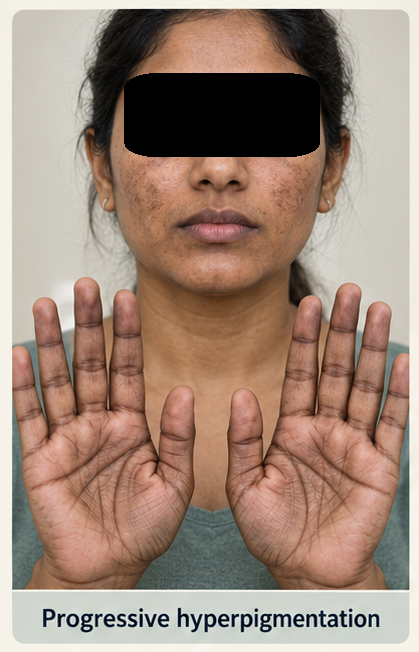
The skin changes initially appeared over the knuckles and palmar creases before gradually involving the face, elbows, knees, and areas exposed to friction. Family members had also noticed darkening of her lips and oral mucosa.
There was no history of fever, persistent vomiting, diarrhoea, gastrointestinal bleeding, chronic cough, haemoptysis, or recent infection.
She denied prolonged corticosteroid therapy, abrupt withdrawal of steroids, anticoagulant use, abdominal trauma, or previous adrenal surgery.
There was no history of diabetes mellitus, hypertension, renal disease, or known pituitary disorder. Her mother had autoimmune hypothyroidism, but there was no family history of adrenal disease.
Her menstrual cycles had become irregular during the preceding four months. There was no history of pregnancy, excessive menstrual bleeding, galactorrhoea, headache, or visual disturbance.
On examination, the patient appeared thin and mildly dehydrated. Her weight was 48 kg, height was 1.61 m, and body mass index was 18.5 kg/m².
Supine blood pressure was 96/62 mmHg and decreased to 76/50 mmHg after standing. Her pulse increased from 88 to 108 beats per minute, indicating significant postural hypotension.
Diffuse brownish hyperpigmentation was observed over the face, neck, elbows, knees, knuckles, and palmar creases. Pigmentation was also present over the gingiva and buccal mucosa.
There was no pallor, icterus, cyanosis, lymphadenopathy, pedal oedema, vitiligo, or skin rash.
Cardiovascular examination revealed tachycardia without a murmur. Respiratory, abdominal, and neurological examinations were otherwise unremarkable.
The combination of progressive weakness, weight loss, salt craving, postural hypotension, and mucocutaneous hyperpigmentation raised strong suspicion of primary adrenal insufficiency.
Investigations
Initial laboratory investigations showed:
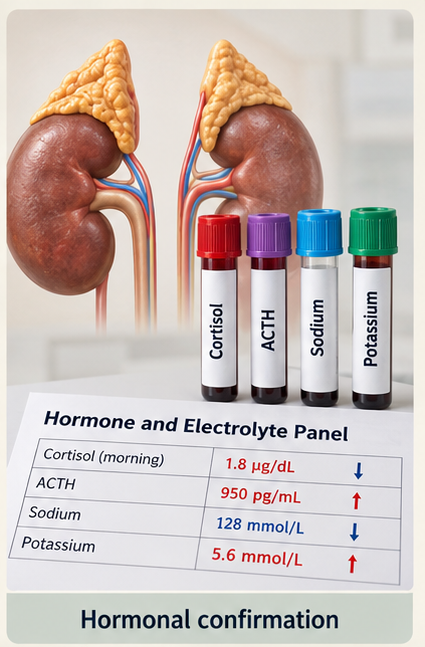
- Serum sodium: 123 mmol/L
- Serum potassium: 5.8 mmol/L
- Serum chloride: 92 mmol/L
- Fasting plasma glucose: 68 mg/dL
- Serum creatinine: 1.3 mg/dL
- Blood urea nitrogen: 29 mg/dL
Haemoglobin was 11.8 g/dL. The total leucocyte count and platelet count were within reference ranges. Mild eosinophilia was present.
The 8:00 AM serum cortisol level was low at 2.1 µg/dL. Plasma adrenocorticotropic hormone was markedly elevated at more than 1,250 pg/mL, supporting primary rather than secondary adrenal insufficiency.
During a short adrenocorticotropic hormone stimulation test, serum cortisol failed to increase adequately, confirming adrenal insufficiency.
Plasma renin activity was elevated, while serum aldosterone was low. These findings indicated associated mineralocorticoid deficiency.
Testing for 21-hydroxylase antibodies was positive, supporting autoimmune adrenalitis as the underlying cause.
Thyroid-stimulating hormone was mildly elevated, but free thyroxine was within its reference range. Thyroid peroxidase antibodies were positive, indicating possible evolving autoimmune thyroid disease.
Screening for type 1 diabetes mellitus and coeliac disease was negative. Serum vitamin B12, calcium, and liver-function parameters were within normal limits.
An electrocardiogram showed sinus tachycardia without clinically significant changes related to hyperkalaemia.
Chest radiography was normal. Contrast-enhanced computed tomography of the abdomen showed mildly reduced adrenal gland volume without enlargement, calcification, haemorrhage, or focal mass.
Testing for tuberculosis was negative. There was no clinical or radiological evidence of infection, metastatic disease, or adrenal infiltration.
Based on the clinical presentation and biochemical findings, autoimmune Addison disease was diagnosed.
Differential Diagnosis
Secondary Adrenal Insufficiency
Secondary adrenal insufficiency may cause weakness, weight loss, hypotension, hyponatraemia, and low cortisol. However, marked hyperpigmentation, hyperkalaemia, elevated adrenocorticotropic hormone, and mineralocorticoid deficiency strongly favoured primary adrenal insufficiency.
Chronic Gastrointestinal Disease
Chronic gastrointestinal disease may produce weight loss, weakness, nausea, and electrolyte abnormalities. However, there was no persistent diarrhoea, gastrointestinal bleeding, or malabsorption, and the hormonal findings confirmed adrenal insufficiency.
Hypothyroidism
Hypothyroidism can cause fatigue, weakness, and hyponatraemia. It would not explain the combination of hyperkalaemia, postural hypotension, low cortisol, and markedly elevated adrenocorticotropic hormone.
Haemochromatosis
Haemochromatosis may produce hyperpigmentation and endocrine dysfunction. However, iron studies were normal, and there was no diabetes, liver dysfunction, or evidence of iron overload.
Drug-Related or Exogenous Steroid-Induced Adrenal Insufficiency
Chronic glucocorticoid exposure and abrupt withdrawal may suppress the hypothalamic-pituitary-adrenal axis. The patient denied steroid exposure, and this mechanism usually produces low or inappropriately normal adrenocorticotropic hormone without hyperkalaemia or marked hyperpigmentation.
Adrenal Tuberculosis
Tuberculosis remains an important cause of primary adrenal insufficiency in endemic areas. It was considered because of the regional relevance, but the absence of constitutional or respiratory symptoms, negative tuberculosis evaluation, lack of adrenal enlargement or calcification, and positive 21-hydroxylase antibodies supported autoimmune adrenalitis.
Management and Outcome
Blood samples for cortisol and adrenocorticotropic hormone were collected before treatment. Because the patient had symptomatic hypotension, dehydration, and marked electrolyte abnormalities, treatment was initiated without waiting for all confirmatory results.

She received intravenous isotonic saline and hydrocortisone under close clinical and biochemical monitoring.
Her blood pressure, nausea, and general wellbeing improved following fluid and glucocorticoid replacement. Serum sodium increased gradually, while potassium and renal-function parameters returned to normal.
After clinical stabilisation, she was transitioned to oral hydrocortisone in divided doses to approximate the normal circadian pattern of cortisol secretion.
Fludrocortisone was initiated for mineralocorticoid replacement. Its dose was subsequently adjusted according to blood pressure, postural symptoms, serum electrolytes, and plasma renin.
The patient received detailed counselling regarding lifelong hormone replacement. She was advised not to discontinue glucocorticoid therapy abruptly.
Sick-day rules were explained, including the need to increase glucocorticoid replacement during febrile illness and seek urgent medical care when persistent vomiting prevented oral medication.
She was provided with a steroid emergency card and advised to wear medical identification. The patient and a family member were taught how and when to administer emergency injectable hydrocortisone.
At the one-month follow-up, appetite and energy levels had improved considerably. Postural dizziness had resolved, and blood pressure was stable without a significant postural decrease.
Serum sodium and potassium remained within reference ranges. The patient had gained 2 kg and had resumed most routine activities.
At three months, she reported sustained symptomatic improvement and regular adherence to treatment. Hyperpigmentation over the face, palmar creases, and oral mucosa had become less prominent but remained visible.
She continued endocrinology follow-up for dose monitoring and surveillance for associated autoimmune disorders.
Discussion
This case demonstrates the gradual and easily overlooked presentation of Addison disease. Fatigue, weakness, reduced appetite, gastrointestinal symptoms, and weight loss are common but nonspecific features and may initially be attributed to nutritional, gastrointestinal, psychiatric, or infectious conditions.
Hyperpigmentation provided an important diagnostic clue. In primary adrenal insufficiency, reduced cortisol secretion removes negative feedback on the hypothalamic-pituitary axis, resulting in increased production of proopiomelanocortin-derived peptides, including adrenocorticotropic hormone. Increased melanocortin activity stimulates pigmentation.
Pigmentation involving the palmar creases, knuckles, pressure points, scars, and oral mucosa is particularly suggestive. Its absence, however, does not exclude primary adrenal insufficiency.
Mineralocorticoid deficiency contributes to renal sodium loss, volume depletion, hypotension, salt craving, and hyperkalaemia. Cortisol deficiency may additionally contribute to fatigue, weight loss, nausea, hypoglycaemia, and impaired vascular responsiveness.
A low morning cortisol concentration raises suspicion of adrenal insufficiency, while an elevated adrenocorticotropic hormone level supports a primary adrenal cause. An adrenocorticotropic hormone stimulation test is generally used for confirmation when the patient is clinically stable.
Low aldosterone with elevated renin supports mineralocorticoid deficiency. Testing for 21-hydroxylase antibodies helps identify autoimmune adrenalitis, while adrenal imaging and targeted infectious investigations may be required when antibody testing is negative or an alternative cause is suspected.
Autoimmune Addison disease may occur alone or as part of an autoimmune polyglandular syndrome. Patients therefore require assessment for associated thyroid disease, type 1 diabetes mellitus, coeliac disease, premature ovarian insufficiency, autoimmune gastritis, and vitamin B12 deficiency when clinically indicated.
Treatment requires lifelong glucocorticoid replacement and, in most patients with primary adrenal insufficiency, mineralocorticoid replacement. Therapy should be individualised to control symptoms while avoiding chronic over-replacement.
Patient education is as important as pharmacological treatment. Intercurrent infection, trauma, surgery, prolonged vomiting, or failure to increase glucocorticoid doses appropriately can precipitate adrenal crisis.
Suspected adrenal crisis requires immediate treatment with parenteral hydrocortisone and intravenous isotonic saline. Diagnostic testing should not delay life-saving therapy.

Conclusion
Addison disease should be considered in patients presenting with unexplained fatigue, weight loss, postural dizziness, gastrointestinal symptoms, salt craving, or progressive hyperpigmentation.
In this illustrative case, the combination of mucocutaneous pigmentation, hypotension, hyponatraemia, hyperkalaemia, low morning cortisol, and markedly elevated adrenocorticotropic hormone led to the diagnosis of autoimmune primary adrenal insufficiency.
Glucocorticoid and mineralocorticoid replacement resulted in rapid haemodynamic and biochemical improvement, followed by gradual recovery of appetite, weight, energy, and skin pigmentation.
Early diagnosis, lifelong replacement therapy, sick-day education, emergency hydrocortisone access, and screening for associated autoimmune disorders are essential for preventing adrenal crisis and improving long-term outcomes.
References
- Bornstein SR, Allolio B, Arlt W, et al. Diagnosis and treatment of primary adrenal insufficiency: An Endocrine Society clinical practice guideline. Journal of Clinical Endocrinology and Metabolism. 2016;101(2):364–389 https://pmc.ncbi.nlm.nih.gov/articles/PMC4880116/
- Pazderska A, Pearce SHS. Adrenal insufficiency: Recognition and management. Clinical Medicine. 2017;17(3):258–262. https://pmc.ncbi.nlm.nih.gov/articles/PMC6297573/
- Arlt W; Society for Endocrinology Clinical Committee. Emergency management of acute adrenal insufficiency in adult patients. Endocrine Connections. 2016;5(5):G1–G3 https://pmc.ncbi.nlm.nih.gov/articles/PMC5314805/
- Husebye ES, Allolio B, Arlt W, et al. Consensus statement on the diagnosis, treatment and follow-up of patients with primary adrenal insufficiency. Journal of Internal Medicine. 2014;275(2):104–115. https://pubmed.ncbi.nlm.nih.gov/24330030/
- Bancos I, Hahner S, Tomlinson JW, Arlt W. Diagnosis and management of adrenal insufficiency. The Lancet Diabetes and Endocrinology. 2015;3(3):216–226 https://pubmed.ncbi.nlm.nih.gov/25098712
Read more such content on @ Hidoc Dr | Medical Learning App for Doctors
Recommended News For You
Recommended Articles For You
Featured News
Featured Articles
Featured Events
Featured KOL Videos
1.
Tumor characteristics found to differ for melanomas in children, teens and young adults
2.
Unexplained CAR-T Death; Americans Spurn Sunscreen; Improving Diversity in Trials
3.
"A lot" of aspirin reduces the risk of ovarian cancer, regardless of genetic factors, according to the JAMA study.
4.
Approval in Endometrial Cancer Expanded; Masks at Cancer Centers; NPR Reporter Dies
5.
Is Lenalidomide Resistance in Myeloma Reversible with JAK Inhibition?
1.
Modern Oncology Unveiled with Treatment Innovations and Personalized Cancer Care
2.
Screening for Early Therapy-Related Cancer Susceptibility
3.
Unlocking the Potential of Bicalutamide 50 mg: A Revolutionary New Treatment for Prostate Cancer
4.
Skin-Sparing Mastectomy: Balancing Cancer Control with Cosmetic Results
5.
Reducing Modifiable Childhood Cancer Exposure Risks
1.
International Conference on Innovations in Critical Care for Oncology and Cardiology
2.
International Conference on Oncology, Cardiology and Critical Care Policy
3.
International Conference on Oncology, Cancer Prevention and Public Health
4.
International Conference on Cancer Nursing and Rehabilitation Strategies
5.
International Conference on Best Practices in Oncology, Cardiology and Critical Care
1.
Dacomitinib Case Presentation: Baseline Treatment and Current Status
2.
Targeting Oncologic Drivers with Dacomitinib: Further Discussion on Lung Cancer Treatment
3.
Should We Use DARA Up Front As First-Line Therapy in MM?
4.
Iron Deficiency Anemia: Ferric Maltol As a New Treatment Option- A New Perspective
5.
Importance of Cancer Screening and Early Detection

Address :
Hidoc Dr. Inc. | Delaware C Corp | 1309 Coffeen Ave. Suite 1200, Sheridan WY, 82801
Phone :
+1-415-463-3094
Email :
anishagadia@hidoc.co
© Copyright 2026 Hidoc Dr. Inc.
Terms & Conditions - LLP | Inc. | Privacy Policy - LLP | Inc. | Account Deactivation

To get started please enter your email ID
Welcome to Hidoc Dr.
Join to enhance your clinical skills and gain specialized in-depth medical knowledge