Acute Bacterial Parotitis: A Case Report of Unilateral Parotid Swelling, Suppurative Infection, and Clinical Management
OthersPage Navigation
Abstract
Acute bacterial parotitis is an infection of the parotid gland characterized by sudden painful swelling, tenderness, and inflammation of the affected gland. The infection commonly develops through retrograde migration of oral bacteria through Stensen’s duct, particularly when salivary flow is reduced. Staphylococcus aureus is the organism most frequently associated with acute suppurative parotitis, although streptococci, anaerobic organisms, and Gram-negative bacteria may also be involved. [1,2]
We describe a representative case of an adult patient who presented with acute unilateral facial swelling, pain over the parotid region, fever, and discomfort during chewing. Clinical examination demonstrated a tender, enlarged parotid gland with overlying erythema. Gentle massage of the gland produced purulent material from Stensen’s duct. Laboratory evaluation showed inflammatory changes, while ultrasonography demonstrated an enlarged inflamed parotid gland without a drainable abscess.
The patient was diagnosed with acute bacterial suppurative parotitis and managed with antimicrobial therapy, adequate hydration, analgesia, warm compresses, gland massage, oral hygiene, and measures to stimulate salivary flow. Progressive clinical improvement was observed, with resolution of fever, pain, and parotid swelling without development of an abscess or other complications.
This case highlights the importance of recognizing the characteristic presentation of acute bacterial parotitis, evaluating for suppuration and abscess formation, initiating appropriate antimicrobial and supportive treatment, and monitoring for potentially serious complications.
Introduction
Parotitis refers to inflammation of the parotid gland and may have infectious and noninfectious causes. Acute bacterial parotitis, also termed acute suppurative parotitis, is an uncommon but potentially serious bacterial infection of the parotid gland. It typically presents with sudden painful swelling of the affected gland, tenderness, erythema, fever, and occasionally purulent discharge from Stensen’s duct. [1]
The infection generally occurs when bacteria from the oral cavity migrate retrogradely through the parotid duct. Reduced salivary flow facilitates bacterial colonization because normal salivary secretion and ductal flushing help limit ascending infection. Dehydration, poor oral hygiene, reduced oral intake, salivary duct obstruction, medications that decrease salivary secretion, advanced age, and systemic illness can therefore predispose patients to acute bacterial parotitis. [1,2]
Staphylococcus aureus is the most frequently identified causative organism. Streptococcal species, anaerobic organisms, and Gram-negative bacteria have also been implicated. [2,3]
Although many cases respond to antimicrobial and supportive treatment, untreated or progressive infection may result in parotid abscess, extension into adjacent deep neck spaces, sepsis, fistula formation, or other complications. Early clinical recognition and appropriate management are therefore important. [1,4]
Case Report
An adult patient presented with acute-onset painful swelling involving the right side of the face in the preauricular and mandibular region.
The swelling had progressively increased over several days and was associated with localized pain and tenderness. The patient also reported fever, malaise, and increased discomfort while chewing.
There was no recent facial trauma or surgical procedure involving the parotid region. There was no previous history of recurrent parotid swelling.
On examination, the patient was febrile but hemodynamically stable. A diffuse swelling was visible over the right parotid region, extending from the preauricular area toward the angle of the mandible.
The affected area was warm, tender, and mildly erythematous. The right parotid gland was enlarged and firm on palpation.

Intraoral examination demonstrated inflammation around the opening of the right Stensen’s duct. Gentle external massage of the parotid gland resulted in expression of purulent material from the duct.

There was no clinically evident facial nerve weakness or respiratory compromise.
Based on the acute unilateral painful parotid swelling, inflammatory findings, fever, and purulent ductal discharge, acute bacterial suppurative parotitis was suspected.
Investigations
Clinical evaluation was supported by laboratory and imaging investigations.
Complete blood count demonstrated leukocytosis with neutrophilic predominance, supporting an acute bacterial inflammatory process. Inflammatory markers were elevated.
Purulent material expressed from Stensen’s duct was collected for Gram staining, bacterial culture, and antimicrobial susceptibility testing.
Ultrasonography of the right parotid region demonstrated:
- Enlargement of the right parotid gland
- Heterogeneous glandular echotexture
- Increased inflammatory changes within the gland
- No definite focal fluid collection or drainable abscess
- No obvious obstructing calculus
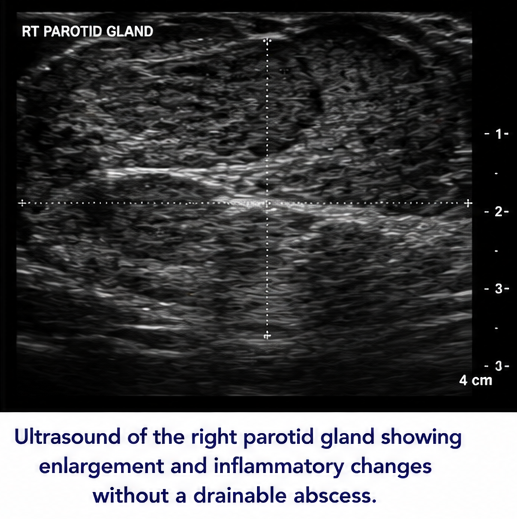
The contralateral parotid gland showed no significant abnormality.
Because there was no clinical or ultrasonographic evidence of deep neck extension or a large abscess, additional cross-sectional imaging was not initially required.
Diagnosis
The diagnosis was based on:
- Acute unilateral parotid-region swelling
- Significant localized pain and tenderness
- Overlying warmth and erythema
- Fever and systemic symptoms
- Enlarged and tender parotid gland
- Purulent discharge from Stensen’s duct
- Laboratory evidence of acute inflammation
- Ultrasonographic evidence of parotid inflammation
- Absence of a drainable parotid abscess
The overall findings were consistent with acute bacterial suppurative parotitis.
Management and Outcome
Treatment was initiated promptly to control the bacterial infection, restore salivary flow, relieve symptoms, and prevent abscess formation or spread of infection.
The patient received appropriate antimicrobial therapy with coverage for common bacterial organisms associated with acute suppurative parotitis. Antimicrobial treatment was subsequently reviewed according to the clinical response and microbiological findings.
Adequate hydration was maintained to improve salivary secretion and correct any contribution from reduced fluid intake.
Supportive treatment included analgesia, warm compresses over the affected parotid region, gentle parotid gland massage, and maintenance of good oral hygiene.
Measures to stimulate salivary secretion were encouraged where appropriate. Increased salivary flow, together with gentle gland massage, was used to promote drainage through Stensen’s duct.
The patient was closely monitored for persistence of fever, increasing facial swelling, worsening pain, fluctuance, facial nerve dysfunction, or evidence of deep neck infection.
During treatment, fever and systemic symptoms gradually subsided. Parotid tenderness and swelling progressively decreased, and purulent discharge from Stensen’s duct resolved.
No clinical evidence of parotid abscess formation developed, and surgical drainage was not required.
Follow-up
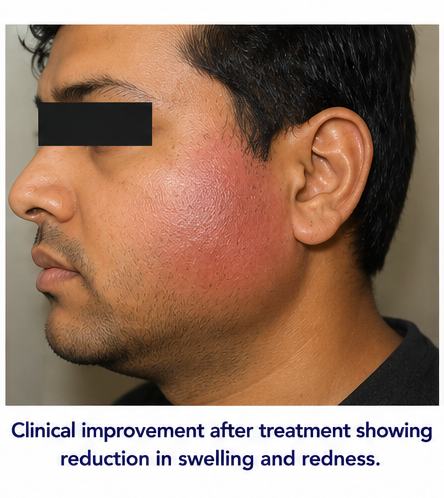
Early Follow-up
- Reduction in fever and systemic symptoms
- Decreased parotid pain and tenderness
- Reduction in facial swelling
- Decreased erythema
- Improvement in oral intake
- Reduced purulent ductal discharge
Subsequent Follow-up
- Significant reduction in parotid enlargement
- Resolution of fever
- Resolution of purulent discharge
- Improved comfort during chewing
- No focal fluctuant swelling
- No evidence of deep neck infection
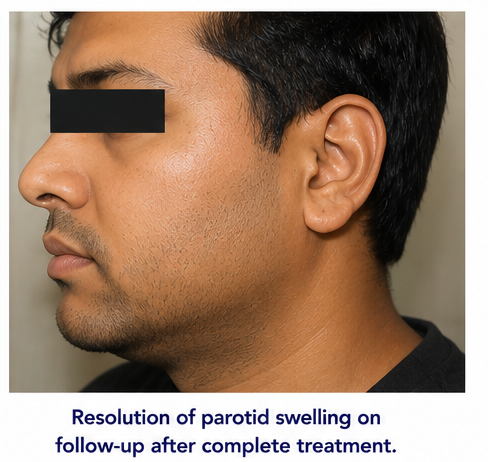
Later Follow-up
- Complete or near-complete resolution of parotid swelling
- No recurrent fever or pain
- Normal salivary drainage
- No facial nerve dysfunction
- No evidence of parotid abscess
- No recurrence of acute infection
Discussion
Acute bacterial parotitis is an ascending bacterial infection involving the parotid gland. Under normal circumstances, continuous salivary secretion and drainage through Stensen’s duct provide an important mechanical defense against ascending oral microorganisms. Reduction in salivary flow can impair this protective mechanism and facilitate retrograde bacterial migration from the oral cavity into the gland. [1,2]
Dehydration is an important predisposing condition because reduced fluid availability can decrease salivary secretion and contribute to salivary stasis. Poor oral hygiene, reduced oral intake, systemic illness, immunosuppression, and medications that decrease salivary secretion may similarly increase susceptibility. Mechanical obstruction of the parotid duct by a calculus or other lesion should also be considered, particularly when infections are recurrent. [1]
Staphylococcus aureus remains the organism most frequently associated with acute suppurative parotitis. Streptococci, anaerobic organisms, and Gram-negative organisms may also cause infection, particularly in specific clinical settings. Microbiological examination of purulent material expressed from Stensen’s duct can therefore be useful for identifying the pathogen and guiding antimicrobial treatment. [2,3]
The clinical presentation is usually characteristic. Patients commonly develop rapidly progressive unilateral swelling and pain involving the parotid region. The gland may be firm and markedly tender, with erythema and warmth of the overlying skin. Fever and other systemic manifestations can accompany the localized findings. [1]
Expression of purulent material from Stensen’s duct following gentle parotid massage strongly supports the diagnosis of acute suppurative parotitis. However, absence of visible pus does not exclude the condition. [1,3]
Imaging helps determine the extent of glandular inflammation and identify complications or underlying obstruction. Ultrasonography is particularly useful because it can demonstrate parotid enlargement and inflammatory changes while evaluating for sialolithiasis and abscess formation. Computed tomography may be considered when the diagnosis is uncertain, symptoms are severe, an abscess is suspected, or extension into adjacent structures needs to be evaluated. [1,4]
Treatment combines antimicrobial therapy with measures designed to restore salivary drainage. Hydration, warm compresses, gland massage, good oral hygiene, analgesia, and stimulation of salivary flow form important components of supportive management. Antimicrobial therapy should provide appropriate coverage for likely bacterial pathogens and may subsequently be adjusted according to culture and susceptibility findings. [1,2]
Clinical reassessment is important after initiation of treatment. Failure to improve should prompt consideration of resistant organisms, an obstructing calculus, inadequate drainage, abscess formation, or extension of infection beyond the parotid gland.
Parotid abscess represents an important complication. When a drainable abscess develops or the infection fails to respond adequately to conservative treatment, image-guided aspiration or surgical drainage may become necessary. [4]
Other uncommon but potentially serious complications include deep neck infection, facial nerve involvement, fistula formation, septicemia, and extension of infection into surrounding anatomical spaces. Early antimicrobial therapy and appropriate supportive care substantially reduce the likelihood of these outcomes. [1,4]
In the present representative case, the acute unilateral painful swelling, fever, inflammatory changes, and purulent discharge from Stensen’s duct supported the diagnosis of acute bacterial suppurative parotitis. Ultrasonography demonstrated glandular inflammation without abscess formation. Improvement following antimicrobial therapy, hydration, salivary stimulation, and local supportive measures further supported the diagnosis.
Prognosis
The prognosis of uncomplicated acute bacterial parotitis is generally favorable when the condition is identified and treated promptly.
Reduction in bacterial infection together with restoration of adequate salivary flow usually results in progressive improvement in fever, pain, tenderness, and glandular swelling.
Patients who fail to demonstrate appropriate clinical improvement require reassessment for abscess formation, ductal obstruction, resistant infection, or extension into surrounding tissues.
Recurrent episodes should prompt evaluation for underlying causes such as salivary duct obstruction, sialolithiasis, chronic reduction in salivary flow, or other disorders affecting the salivary glands.
Conclusion
Acute bacterial parotitis is an acute infection of the parotid gland that commonly presents with painful unilateral parotid swelling, tenderness, fever, and occasionally purulent discharge from Stensen’s duct.
This case demonstrates the importance of careful clinical examination, assessment of ductal drainage, microbiological evaluation where purulent material is available, and imaging to identify abscess formation or an underlying obstructive process.
Prompt antimicrobial therapy combined with adequate hydration, salivary stimulation, gland massage, oral hygiene, analgesia, and close clinical monitoring can result in complete recovery in uncomplicated cases.
Early recognition and appropriate follow-up are important because progressive infection can result in parotid abscess, deep neck extension, sepsis, and other potentially serious complications.
References
- Wells J, et al. Parotitis. StatPearls. StatPearls Publishing; updated 2025. https://www.ncbi.nlm.nih.gov/books/NBK560735/
- Brook I. Acute bacterial suppurative parotitis: microbiology and management. Journal of Craniofacial Surgery. https://pubmed.ncbi.nlm.nih.gov/12544218/
- Ismail EA, Seoudi TM, Al-Amir M, et al. Suppurative Parotitis in a Girl: A Case Report From Ahvaz, Iran. Case Reports in Pediatrics. 2014. https://pmc.ncbi.nlm.nih.gov/articles/PMC4255378/
- Saibene AM, Allevi F, Ayad T, et al. Treatment for parotid abscess: a systematic review. Acta Otorhinolaryngologica Italica. 2022;42:106–115. https://pmc.ncbi.nlm.nih.gov/articles/PMC9132006/
- Kato H, Kanematsu M, Watanabe H, et al. Acute suppurative parotitis following acute ischemic stroke: a case report. Cureus. 2022. https://pmc.ncbi.nlm.nih.gov/articles/PMC8860495/
Read more such content on @ Hidoc Dr | Medical Learning App for Doctors
Recommended News For You
Recommended Articles For You
Featured News
Featured Articles
Featured Events
Featured KOL Videos
1.
What Patients Hear From Us: 'Blah, Blah, Tumor, Blah, Blah, Cancer'
2.
A pilot study investigates a novel strategy for lowering anxiety and enhancing post-stem cell transplant quality of life.
3.
Immunotherapy Remains Little Used in Head and Neck Cancer
4.
Enhanced access for patients with prostate cancer is provided by the new SPECT/CT technique, which demonstrates remarkable biomarker identification.
5.
Adjuvant Tx May Boost Survival in Bilateral Breast Cancer
1.
New Anticoagulants: Balancing Efficacy and Safety in Patients with Atrial Fibrillation
2.
Iron Metabolism and Inflammatory Disorders: Mechanisms, Clinical Implications, and Therapeutic Approaches
3.
Precision Oncology: Tailoring Cancer Treatment for the Individual
4.
Survivorship Planning Beyond Active Cancer Care
5.
Biomarkers of Hematopoietic Reserve During Repeated Physiological Stress
1.
International Cancer Conference
2.
Asian Symposium on Advancement in Hematology and Oncology (ASAHO)
3.
International Cancer Conference
4.
Asian Symposium on Advancement in Hematology and Oncology (ASAHO)
5.
Asian Symposium on Advancement in Hematology and Oncology
1.
Pazopanib: A Game-Changer in Managing Advanced Renal Cell Carcinoma - Part V
2.
Current Scenario of Cancer- An Overview of The Incidence of Cancer in Men
3.
Recent Data Analysis for First-Line Treatment of ALK+ NSCLC: A Final Discussion
4.
From Relapse to Remission: Mapping the Treatment Journey in Adult R/R-Cell ALL - Part 2
5.
The Era of Targeted Therapies for ALK+ NSCLC: A Paradigm Shift

Address :
Hidoc Dr. Inc. | Delaware C Corp | 1309 Coffeen Ave. Suite 1200, Sheridan WY, 82801
Phone :
+1-415-463-3094
Email :
anishagadia@hidoc.co
© Copyright 2026 Hidoc Dr. Inc.
Terms & Conditions - LLP | Inc. | Privacy Policy - LLP | Inc. | Account Deactivation

To get started please enter your email ID
Welcome to Hidoc Dr.
Join to enhance your clinical skills and gain specialized in-depth medical knowledge