Cervical Cancer: A Case Report of a Challenging Clinical Presentation and Management
OthersPage Navigation
Abstract
Cervical cancer is a malignant neoplasm arising from the cervix and remains an important cause of cancer-related morbidity among women. The clinical presentation may include abnormal vaginal bleeding, vaginal discharge, pelvic pain, or symptoms related to locally advanced disease. Early recognition and appropriate diagnostic evaluation are essential for staging and treatment planning.
We report a case of a 45-year-old woman who presented with abnormal vaginal bleeding and foul-smelling vaginal discharge. Clinical examination revealed an irregular growth involving the cervix. Imaging demonstrated a cervical mass with local extension, while histopathological examination confirmed squamous cell carcinoma of the cervix. The patient was diagnosed with locally advanced cervical cancer and managed with definitive concurrent chemoradiotherapy.
This case highlights the importance of recognizing abnormal vaginal bleeding as a potential warning symptom and emphasizes the role of clinical examination, imaging, and histopathological confirmation in the diagnosis and management of cervical cancer.
Introduction
Cervical cancer develops from malignant transformation of cells lining the cervix. The disease may remain clinically silent during its early stages but can present with abnormal vaginal bleeding, postcoital bleeding, vaginal discharge, or pelvic discomfort as it progresses.
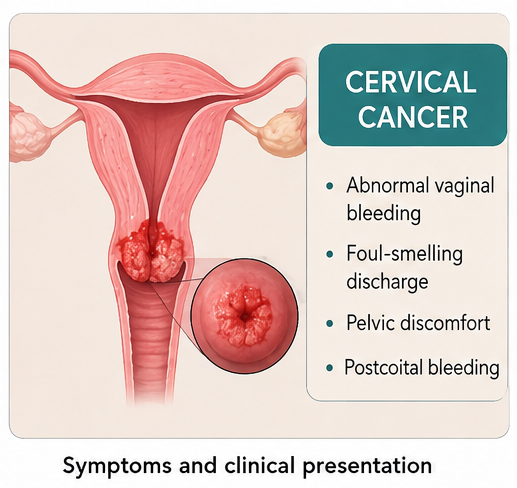
Diagnosis requires appropriate clinical assessment and histopathological confirmation. Imaging studies help evaluate local disease extension and involvement of surrounding structures, while staging guides treatment selection.
Management depends on the stage and extent of disease and may include surgery, radiotherapy, chemotherapy, or combined treatment approaches.
We report a hypothetical case of cervical cancer presenting with abnormal vaginal bleeding and vaginal discharge, with subsequent clinical, radiological, and histopathological evaluation confirming the diagnosis.
Case Report
A 45-year-old woman presented with a 3-month history of abnormal vaginal bleeding, particularly after sexual intercourse, associated with intermittent foul-smelling vaginal discharge. She also reported lower abdominal discomfort and generalized fatigue.
There was no significant history of previous malignancy. Her menstrual cycles had previously been regular. She had not undergone regular cervical cancer screening.
On general examination, the patient was conscious and oriented but appeared mildly pale. Vital signs were stable. Abdominal examination revealed mild lower abdominal tenderness without a palpable mass.
Pelvic examination revealed an irregular, friable growth involving the cervix that bled easily on contact. The lesion appeared to extend beyond the visible cervical surface, raising suspicion of an underlying cervical malignancy.
Investigations
Laboratory investigations revealed mild anemia. Renal and hepatic biochemical parameters were within acceptable limits.
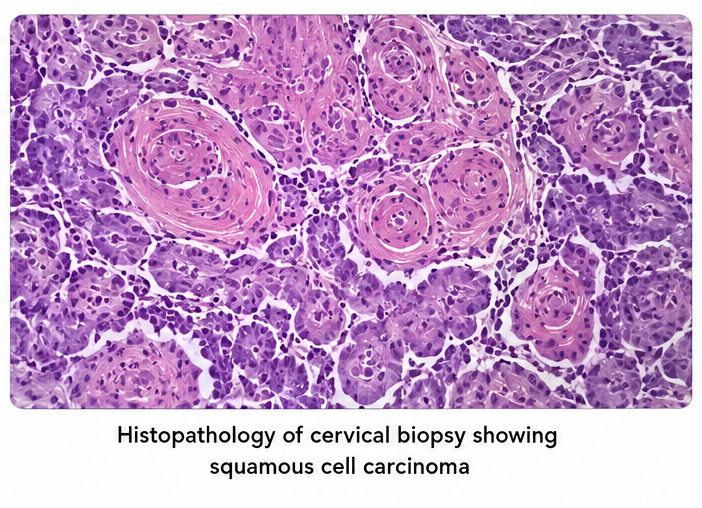
Cervical biopsy was performed from the suspicious lesion. Histopathological examination demonstrated nests and sheets of malignant squamous epithelial cells with nuclear pleomorphism and abnormal keratinization, consistent with squamous cell carcinoma of the cervix.
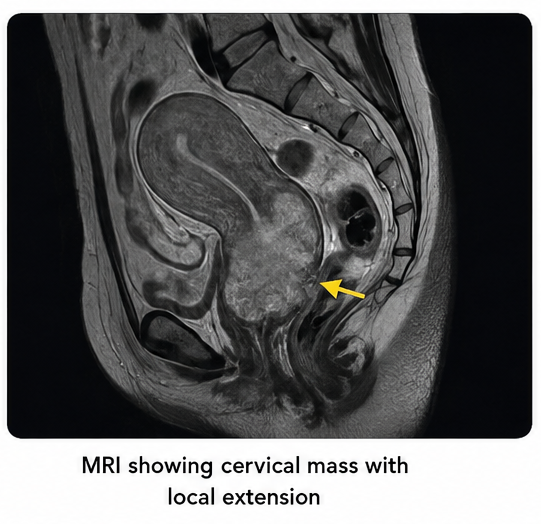
Pelvic magnetic resonance imaging demonstrated a cervical mass with extension into the surrounding parametrial tissues.
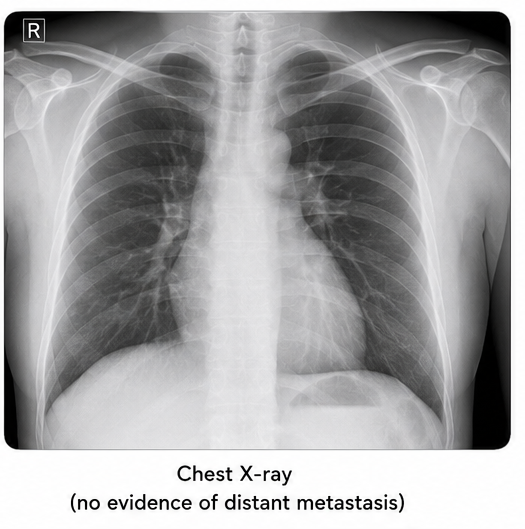
There was no evidence of distant metastatic disease on staging evaluation.
Based on the clinical, radiological, and histopathological findings, the patient was diagnosed with locally advanced cervical squamous cell carcinoma.
Diagnosis
The diagnosis was established based on:
- Abnormal vaginal and postcoital bleeding
- Friable cervical growth on pelvic examination
- Histopathological confirmation of squamous cell carcinoma
- Imaging demonstrating local extension of the cervical lesion
The overall findings were consistent with locally advanced cervical cancer.
Management and Outcome
After multidisciplinary evaluation, definitive concurrent chemoradiotherapy was planned.
The patient received external-beam radiotherapy to the pelvis with concurrent cisplatin-based chemotherapy, followed by brachytherapy as part of definitive treatment.
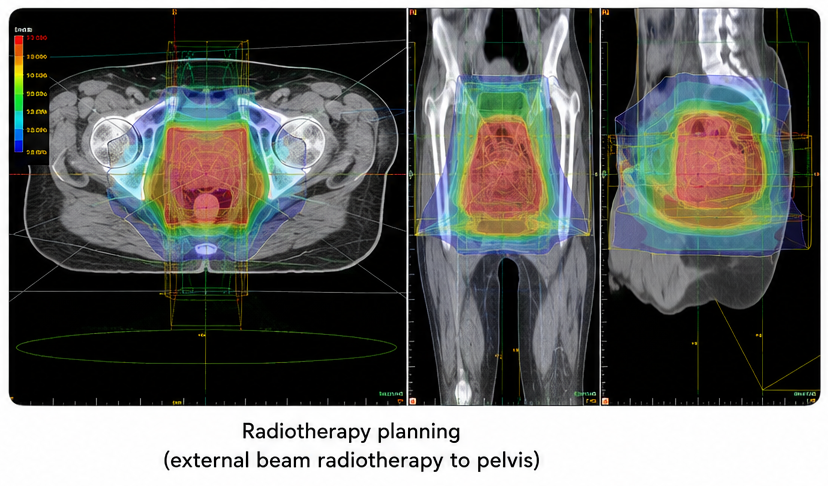
Treatment was completed with regular clinical monitoring. The patient experienced treatment-related fatigue and gastrointestinal symptoms, which were managed symptomatically.
At subsequent assessment, there was significant reduction in the cervical lesion and improvement in abnormal vaginal bleeding and discharge.
Follow-up
Six Weeks
- Marked reduction in abnormal vaginal bleeding
- Decreased vaginal discharge
- Improvement in pelvic discomfort
- Reduction in the clinically apparent cervical lesion
Three Months
- No significant recurrent vaginal bleeding
- Further clinical regression of the cervical lesion
- Improved general well-being
- No new symptoms suggestive of disease progression
Six Months
- Continued clinical improvement
- No evidence of clinically apparent recurrent disease
- Improved functional status
- Continued oncological surveillance
Discussion
Cervical cancer can present with a range of symptoms depending on the stage of disease. Abnormal vaginal bleeding, particularly postcoital bleeding, is an important clinical warning sign that warrants further evaluation.
Pelvic examination remains an important component of assessment when cervical malignancy is suspected. A friable or irregular cervical lesion that bleeds easily should prompt appropriate diagnostic investigation.
Histopathological examination of a cervical biopsy provides definitive confirmation of malignancy and helps establish the tumor type. Imaging contributes to assessment of local extension and evaluation for metastatic disease, thereby supporting treatment planning.
Treatment selection is primarily determined by the stage and extent of disease. Early-stage disease may be managed surgically in appropriately selected patients, whereas locally advanced disease commonly requires combined radiation and systemic treatment.
This hypothetical case demonstrates the importance of timely evaluation of abnormal vaginal bleeding and the role of coordinated clinical, pathological, and radiological assessment in establishing the diagnosis of cervical cancer.
Prognosis
The prognosis of cervical cancer depends on several factors, including the stage of disease, tumor characteristics, extent of local involvement, lymph-node status, presence of distant spread, and response to treatment. These factors help determine the expected clinical course and guide decisions regarding treatment and follow-up.
Early recognition, accurate staging, and timely initiation of appropriate treatment can improve clinical outcomes. Patients who have completed treatment require regular follow-up to assess treatment response, monitor for recurrence, identify late treatment-related complications, and address ongoing physical or functional concerns. Continued clinical surveillance is therefore an important component of long-term cervical cancer care.
Conclusion
Cervical cancer should be considered in women presenting with abnormal vaginal or postcoital bleeding, particularly when symptoms are persistent, recurrent, or associated with a suspicious cervical lesion. Prompt clinical evaluation is important to avoid delays in diagnosis and treatment.
This hypothetical case highlights the importance of thorough pelvic examination, histopathological confirmation through biopsy, imaging-based staging, and appropriate multidisciplinary treatment planning. Early recognition, accurate diagnosis, timely staging, and initiation of appropriate management remain essential for improving outcomes and supporting long-term disease monitoring in patients with cervical cancer.
References
- Bhatla N, Aoki D, Sharma DN, Sankaranarayanan R. Cancer of the cervix uteri. Int J Gynaecol Obstet. 2018;143(Suppl 2):22-36. https://pubmed.ncbi.nlm.nih.gov/30306584/
- Cohen PA, Jhingran A, Oaknin A, Denny L. Cervical cancer. Lancet. 2019;393(10167):169-182. https://pubmed.ncbi.nlm.nih.gov/30638582/
- Small W Jr, Bacon MA, Bajaj A, et al. Cervical cancer: a global health crisis. Cancer. 2017;123(13):2404-2412. https://pubmed.ncbi.nlm.nih.gov/28464289/
- Arbyn M, Weiderpass E, Bruni L, et al. Estimates of incidence and mortality of cervical cancer in 2018: a worldwide analysis. Lancet Glob Health. 2020;8(2):e191-e203. https://pubmed.ncbi.nlm.nih.gov/31812369/
- Okunade KS. Human papillomavirus and cervical cancer. J Obstet Gynaecol. 2020;40(5):602-608. https://pubmed.ncbi.nlm.nih.gov/31500479/
Read more such content on @ Hidoc Dr | Medical Learning App for Doctors
Recommended News For You
Recommended Articles For You
Featured News
Featured Articles
Featured Events
Featured KOL Videos
1.
We Don't Always Know What's 'Best' for Our Patients
2.
FAPI PET/CT enhances the staging of recently discovered breast cancer, according to comparative analysis.
3.
DBT Reduced Suicide Attempts in Adolescents with Bipolar Disorder.
4.
Axatilimab Demonstrates Effectiveness in Refractory/Recurrent GVHD.
5.
AI Framework Helps Classify Renal Tumors, Predict Outcomes
1.
The Genetics of Bernard Soulier Syndrome: What We Know so Far
2.
The New Frontier of Cancer Survivorship: Navigating the Long-Term Effects of Immunotherapy and Targeted Therapies
3.
Exploring the Mystery of Angiokeratomas on Scrotum: Causes, Symptoms and Treatment
4.
IGF2BP1 in Blood Disorders: Therapeutic Potential and Comprehensive Functional Insights
5.
Survivorship Care Planning Beyond Active Cancer Treatment: Advancing Care Continuity for Cancer Survivors
1.
Asian Symposium on Advancement in Hematology and Oncology (ASAHO)
2.
International Cancer Conference
3.
Asian Symposium on Advancement in Hematology and Oncology (ASAHO)
4.
Asian Symposium on Advancement in Hematology and Oncology
5.
Asian Symposium on Advancement in Hematology and Oncology
1.
Pazopanib: A Game-Changer in Managing Advanced Renal Cell Carcinoma - Part VI
2.
ESMO Breast Cancer 2022: P Reality X- A Restrospective Analysis
3.
Preventing Blood Clots: The Importance of Venous Thromboembolism Management
4.
Innovations in Hematology
5.
Revolutionizing Treatment of ALK Rearranged NSCLC with Lorlatinib - Part I

Address :
Hidoc Dr. Inc. | Delaware C Corp | 1309 Coffeen Ave. Suite 1200, Sheridan WY, 82801
Phone :
+1-415-463-3094
Email :
anishagadia@hidoc.co
© Copyright 2026 Hidoc Dr. Inc.
Terms & Conditions - LLP | Inc. | Privacy Policy - LLP | Inc. | Account Deactivation

To get started please enter your email ID
Welcome to Hidoc Dr.
Join to enhance your clinical skills and gain specialized in-depth medical knowledge