Acute Epiglottitis in an Adult Presenting with Severe Sore Throat
OthersPage Navigation
Introduction
Acute epiglottitis involves inflammation and swelling of the epiglottis and adjacent supraglottic structures. It is a potentially life-threatening condition because progressive swelling can obstruct the upper airway. Bacterial infection is a common cause, although noninfectious causes also occur.
Adults may present with severe sore throat, painful swallowing, difficulty swallowing, and voice changes. Symptoms can appear disproportionately severe compared with visible findings in the mouth. Recognising this discrepancy is important to avoid overlooking a deeper airway infection.
Management requires prompt specialist assessment, antimicrobial treatment, and close airway monitoring. Although not every adult requires intubation, deterioration may be unpredictable.
Case Report
A 46-year-old man presented to the emergency department with severe sore throat, fever, and progressively painful swallowing for two days.
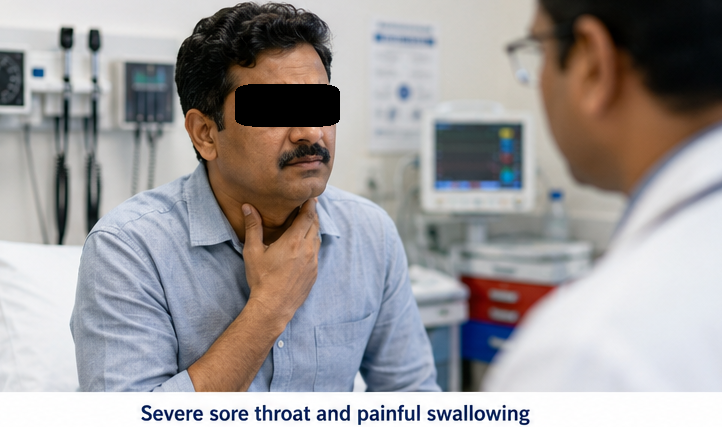
His symptoms initially consisted of mild throat discomfort and malaise. During the preceding twelve hours, swallowing liquids had become increasingly painful, and his voice had developed a muffled quality. He reported reduced oral intake but remained able to swallow his saliva.
There was no history of choking, foreign-body ingestion, recent dental treatment, neck trauma, or exposure to hot liquids or chemical irritants. He denied lip or tongue swelling, urticaria, and recent use of a new medication.
He had no known diabetes, immunosuppressive illness, or previous episodes of similar symptoms.
On examination, he was alert, febrile, and uncomfortable, preferring to remain seated upright. His temperature was 38.6°C, pulse 108 beats/minute, blood pressure 126/78 mmHg, respiratory rate 22 breaths/minute, and oxygen saturation 97% on room air.

He spoke in short sentences because of throat discomfort. There was no stridor at rest, chest retraction, or cyanosis.
Limited inspection of the mouth revealed mild pharyngeal erythema without obvious tonsillar enlargement, exudate, or uvular deviation. Forceful examination and repeated throat manipulation were avoided.
The severity of swallowing pain and the altered voice, despite relatively mild visible pharyngeal findings, prompted urgent otolaryngology and anaesthesia assessment.
Investigations
Airway assessment took priority over laboratory testing and imaging.
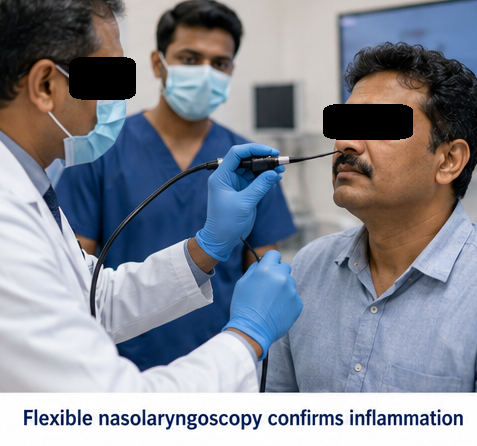
With the patient clinically stable, an otolaryngologist performed flexible nasolaryngoscopy in a monitored setting with immediate airway support available. This demonstrated a markedly erythematous, swollen epiglottis with adjacent aryepiglottic fold oedema. The airway remained patent, and no obvious collection was visualised.
A complete blood count revealed leukocytosis, with a white blood cell count of 16,400/µL and 88% neutrophils. C-reactive protein was elevated at 112 mg/L, supporting an acute inflammatory process.
Haemoglobin was 14.1 g/dL and the platelet count was 278,000/µL, both within reference ranges. Serum creatinine was 0.9 mg/dL, indicating preserved renal function, while serum lactate was not elevated at 1.4 mmol/L.
Flexible nasolaryngoscopy demonstrated a swollen, erythematous epiglottis with associated aryepiglottic fold oedema, consistent with acute epiglottitis. Blood cultures showed no growth, and no bloodstream pathogen was identified.
Blood cultures were collected without delaying antibiotic administration. A direct epiglottic swab was not attempted because unnecessary manipulation could compromise the airway.
CT imaging was deferred because the endoscopic findings established the diagnosis and there was no immediate clinical indication to investigate a deep neck collection.
The working diagnosis was acute epiglottitis with supraglottic inflammation, presumed infectious, without immediate airway obstruction. Negative blood cultures did not establish a noninfectious cause.
Differential Diagnosis
Acute pharyngitis or tonsillitis
These were initially considered because of fever and sore throat. However, the severe swallowing pain, muffled voice, and limited tonsillar findings suggested disease beyond the visible oropharynx.
Peritonsillar abscess
The altered voice and painful swallowing could occur with a peritonsillar abscess. Absence of unilateral tonsillar swelling, uvular deviation, and trismus made this less likely.
Retropharyngeal or other deep neck infection
These remained considerations, particularly if neck swelling, restricted movement, persistent fever, or poor treatment response developed. Further imaging would have been considered once airway safety was assured.
Angioedema
This was less likely given the febrile illness, inflammatory findings, and absence of lip or tongue swelling or a relevant exposure history.
Foreign-body injury or thermal irritation
The patient denied a precipitating event, and nasolaryngoscopy did not identify a foreign body or a focal traumatic lesion.
Management and Outcome
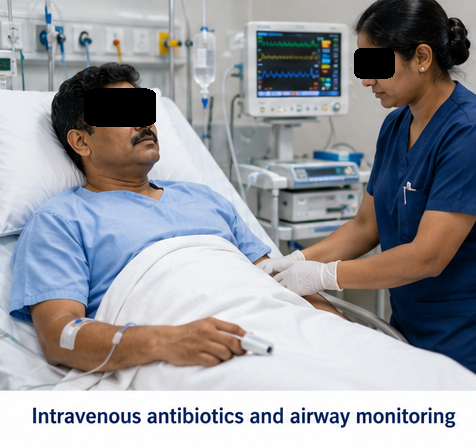
The patient was admitted to the intensive care unit for continuous monitoring and frequent reassessment.
He remained upright and was initially kept nil by mouth. Intravenous fluids and analgesia were provided, with unnecessary sedation avoided.
After joint assessment by otolaryngology and anaesthesia, immediate intubation was deferred because he was maintaining oxygenation, handling secretions, and showing no stridor or increasing respiratory effort. A clear escalation plan was established, with advanced airway equipment and emergency surgical airway capability immediately available.
Empirical intravenous ceftriaxone with antistaphylococcal coverage was initiated according to the hospital’s antimicrobial protocol. Treatment was subsequently reviewed in light of culture findings, clinical progress, and local resistance patterns.
Over the next 24 hours, his fever and throat pain decreased. He developed no stridor, drooling, or respiratory distress.
Repeat nasolaryngoscopy at 48 hours demonstrated substantial improvement in supraglottic swelling. Oral fluids were reintroduced after reassessment, followed by a soft diet.
He was transferred out of intensive care and later discharged on an appropriate oral antibiotic regimen to complete the prescribed course.
At follow-up one week after discharge, swallowing and voice had returned to normal. Repeat examination demonstrated resolution of the swelling.

Discussion
This illustrative presentation highlights a useful diagnostic clue: severe throat symptoms with relatively minor findings on oral examination. The epiglottis is not adequately assessed through routine inspection of the mouth, so an apparently unremarkable throat does not exclude significant supraglottic disease.
Adult epiglottitis requires individualised airway decisions. A retrospective adult cohort demonstrated that many patients could be managed without airway intervention, while a smaller group required urgent procedures. This supports selective intervention within a setting capable of rapidly managing deterioration—not unmonitored observation.
A 2024 systematic review found that airway intervention rates declined over time, approaching approximately 10% in the most recent decade studied. Nevertheless, intubation in epiglottitis remains a high-risk procedure, reinforcing the importance of experienced airway teams and rescue planning.
Investigations must not delay airway management when obstruction is suspected. Flexible endoscopic assessment can establish the diagnosis in an appropriately monitored, stable adult. Imaging is reserved for suitable patients when additional information, such as the presence of an abscess, would influence management.
Conclusion
Acute epiglottitis should be considered in adults with severe sore throat, painful swallowing, and voice changes, especially when visible pharyngeal findings appear insufficient to explain the symptoms.
Early specialist recognition, prompt antibiotics, and closely monitored airway assessment supported recovery in this illustrative case. The absence of initial stridor or hypoxaemia should not lead to complacency.
References
- Dowdy RAE, Cornelius BW. Medical management of epiglottitis. Anesthesia Progress. 2020;67(2):90–97. https://pmc.ncbi.nlm.nih.gov/articles/PMC7342809/
- Felton P, Lutfy-Clayton L, Smith LG, Visintainer P, Rathlev NK. A retrospective cohort study of acute epiglottitis in adults. Western Journal of Emergency Medicine. 2021;22(6):1326–1334. https://pmc.ncbi.nlm.nih.gov/articles/PMC8597686/
- Booth AWG, Pungsornruk K, Llewellyn S, Sturgess D, Vidhani K. Airway management of adult epiglottitis: a systematic review and meta-analysis. BJA Open. 2024;9:100250. https://pmc.ncbi.nlm.nih.gov/articles/PMC10789606/
Read more such content on @ Hidoc Dr | Medical Learning App for Doctors
Recommended News For You
Recommended Articles For You
Featured News
Featured Articles
Featured Events
Featured KOL Videos
1.
Both men and women who receive the HPV vaccine have a lower risk of developing multiple cancer types.
2.
Potentially Novel Approach for Treating Advanced Colorectal Cancer with KRAS Mutations.
3.
CAR-T cell therapy for cancer causes 'brain fog,' study shows
4.
In Acute Myeloid Leukemia Diagnosed Recently, FLT3 Inhibitor Is Very Effective.
5.
Cancer research in the US is world class. With the government pulling out, its future is uncertain
1.
Environmental Carcinogen Exposure Risk Modeling: Current Evidence and Clinical Implications
2.
Screening for Cancer-Related Neuromuscular Weakness: Clinical Approaches and Evidence-Based Strategies
3.
A Closer Look at White Blood Cells in Urine: Uncovering the Causes and Treatments
4.
The Silent Killer: Uncovering the Causes and Treatments of Hemorrhagic Gastritis
5.
Exploring The Causes and Consequences of Low Transferrin Saturation
1.
International Conference on Oncology, Cardiology and Critical Care Policy
2.
International Conference on Innovations in Critical Care for Oncology and Cardiology
3.
International Conference on Oncology, Cancer Prevention and Public Health
4.
International Conference on Cancer Nursing and Rehabilitation Strategies
5.
International Conference on Cancer Nursing and Hematology Support

Address :
Hidoc Dr. Inc. | Delaware C Corp | 1309 Coffeen Ave. Suite 1200, Sheridan WY, 82801
Phone :
+1-415-463-3094
Email :
anishagadia@hidoc.co
© Copyright 2026 Hidoc Dr. Inc.
Terms & Conditions - LLP | Inc. | Privacy Policy - LLP | Inc. | Account Deactivation

To get started please enter your email ID
Welcome to Hidoc Dr.
Join to enhance your clinical skills and gain specialized in-depth medical knowledge