Thoracic Hyperkyphosis Presenting With Progressive Postural Deformity and Chronic Back Pain in an Adolescent: A Case Report
OthersPage Navigation
Introduction
Kyphosis refers to the normal posterior curvature of the thoracic spine. Hyperkyphosis occurs when this curvature becomes excessive, resulting in an exaggerated forward rounding of the upper back.
The condition may develop due to postural abnormalities, congenital vertebral malformations, Scheuermann disease, osteoporosis, or degenerative spinal changes.
Clinical manifestations include rounded shoulders, visible spinal deformity, back pain, muscular fatigue, and reduced spinal flexibility.
Adolescents commonly present with postural kyphosis or Scheuermann kyphosis. Differentiating between these conditions is essential because their management and prognosis differ.
Diagnosis involves clinical examination and standing spinal radiographs. Treatment depends on the severity, flexibility, skeletal maturity, and progression of the deformity.
This illustrative case describes an adolescent presenting with progressive thoracic hyperkyphosis and chronic back pain, subsequently diagnosed with Scheuermann kyphosis.
Case Report
A 16-year-old boy presented to the orthopedic outpatient department with progressive rounding of the upper back and intermittent thoracic back pain for approximately one year.
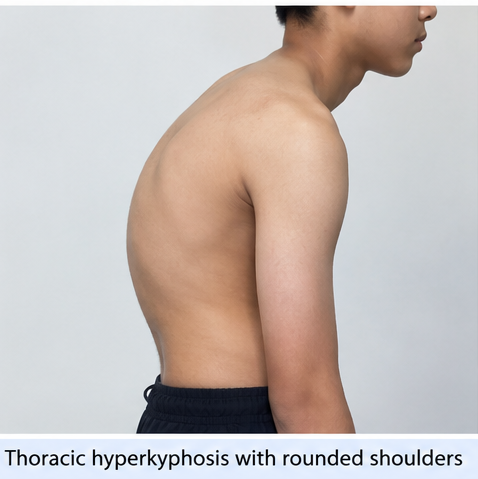
The deformity was initially noticed by his parents and gradually became more prominent over the preceding six months.
The patient reported dull, aching pain in the mid-thoracic region, particularly after prolonged sitting, studying, or physical activity.
Pain was partially relieved by rest. He also experienced occasional muscular fatigue and difficulty maintaining an upright posture.
There was no history of spinal trauma, fever, weight loss, lower-limb weakness, numbness, bowel or bladder dysfunction, or previous spinal surgery.
On examination, the patient was conscious, alert, and hemodynamically stable.
Clinical findings included:
- Temperature: 36.8°C
- Heart rate: 78 beats/minute
- Blood pressure: 116/74 mmHg
- Oxygen saturation: 99% on room air
- Visible thoracic hyperkyphosis with rounded shoulders
- Mild tenderness over the mid-thoracic paraspinal muscles
- Reduced flexibility during attempted spinal extension
The kyphotic deformity persisted during active spinal extension, suggesting a structural rather than purely postural abnormality.
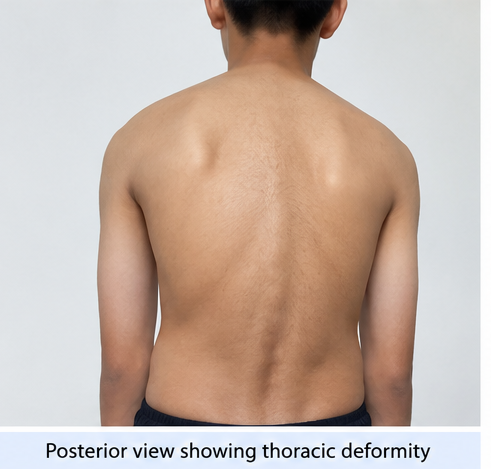
Neurological examination revealed normal muscle strength, sensation, and deep tendon reflexes in both lower limbs.
Gait was normal, and there were no signs of spinal cord compression.
The clinical findings raised suspicion of structural thoracic hyperkyphosis.
Investigations
Standing anteroposterior and lateral radiographs of the thoracic spine demonstrated increased thoracic kyphosis.
Radiographic findings included:
- Thoracic kyphotic Cobb angle of approximately 62°
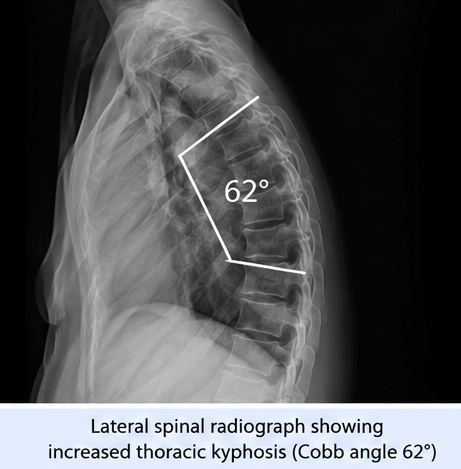
- Anterior wedging exceeding 5° in three consecutive vertebral bodies
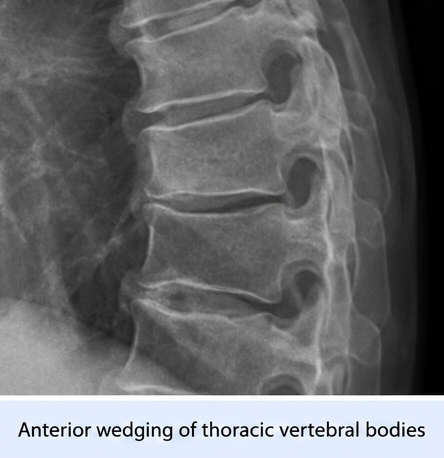
- Mild irregularity of vertebral endplates
- Multiple small Schmorl nodes
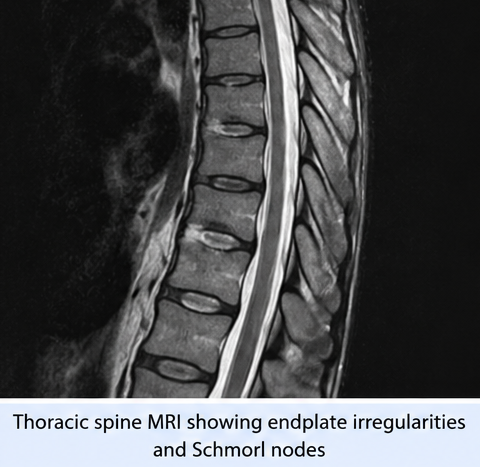
- Narrowing of selected intervertebral disc spaces
The vertebral wedging was predominantly observed between T7 and T10.
Laboratory investigations revealed:
- Hemoglobin: 13.8 g/dL
- White blood cell count: 7,600 cells/µL
- Platelet count: 258,000 cells/µL
- Erythrocyte sedimentation rate: 10 mm/hour
- C-reactive protein: 2 mg/L
- Serum calcium: 9.4 mg/dL
Routine biochemical investigations were within normal limits.
There was no radiographic evidence of vertebral fracture, destructive bony lesions, or congenital vertebral segmentation abnormalities.
MRI was not considered necessary at initial evaluation because there were no neurological deficits or other concerning clinical findings.
Based on the clinical presentation and radiographic features, a diagnosis of Scheuermann kyphosis involving the thoracic spine was established.
Differential Diagnosis
Postural Kyphosis
Postural kyphosis commonly occurs in adolescents and is generally flexible. The persistent deformity during spinal extension and vertebral wedging favored Scheuermann kyphosis.
Congenital Kyphosis
Congenital kyphosis results from vertebral formation or segmentation abnormalities. The absence of congenital vertebral anomalies made this diagnosis unlikely.
Osteoporotic Kyphosis
Osteoporotic vertebral compression fractures may produce excessive thoracic curvature. However, the patient's young age and absence of compression fractures argued against this condition.
Spinal Tuberculosis
Spinal tuberculosis may cause vertebral destruction and angular kyphosis. The absence of constitutional symptoms, inflammatory changes, and destructive vertebral lesions made infection unlikely.
Neuromuscular Kyphosis
Neuromuscular disorders may cause progressive spinal deformity. Normal neurological examination and preserved muscle strength did not support this diagnosis.
Management and Outcome
The patient was managed conservatively under orthopedic supervision.
A structured physiotherapy program was initiated, focusing on spinal extensor strengthening, postural correction, hamstring stretching, and core stabilization.
Because the patient was skeletally immature and had a thoracic kyphotic angle of approximately 62°, treatment with a custom thoracolumbosacral orthosis was recommended.
The patient was advised to wear the brace for approximately 18 hours daily, with periodic assessment of fit, tolerance, and adherence.
Ergonomic modifications were recommended during prolonged sitting and studying.
Oral paracetamol was prescribed as needed for pain relief.
The patient and his parents were educated regarding the importance of treatment adherence and regular orthopedic follow-up.
At the six-week follow-up, the patient reported reduced back pain and improved postural awareness.
At three months, examination demonstrated improved muscular endurance and better tolerance of daily activities.
At six months, standing radiographs showed no significant progression of the kyphotic deformity.
The patient continued physiotherapy and bracing, with periodic clinical and radiographic monitoring planned until skeletal maturity.
Surgical intervention was not recommended because the deformity remained manageable conservatively, with no neurological compromise or severe functional limitation.
Discussion
Scheuermann kyphosis is a structural spinal deformity characterized by excessive thoracic kyphosis associated with anterior wedging of vertebral bodies.
It commonly develops during adolescence and may become more noticeable during periods of rapid skeletal growth.
Unlike postural kyphosis, Scheuermann kyphosis is relatively rigid and cannot be completely corrected through voluntary postural adjustment.
Radiographic diagnosis is commonly supported by anterior wedging of at least 5° in three consecutive vertebrae, although diagnostic criteria and presentation may vary.
Additional findings include vertebral endplate irregularities, Schmorl nodes, and intervertebral disc space narrowing.
In the present case, the combination of progressive thoracic deformity, persistent curvature during extension, and characteristic radiographic abnormalities supported the diagnosis.
Back pain is a frequent presenting symptom, particularly in adolescents with more pronounced deformities.
The severity of symptoms does not always correlate directly with the measured kyphotic angle.
Standing lateral spinal radiographs are essential for evaluating the curvature and identifying structural abnormalities.
MRI may be indicated when neurological symptoms, atypical pain, suspected intraspinal abnormalities, or surgical planning warrant further investigation.
Management depends on the degree of curvature, skeletal maturity, symptoms, and risk of progression.
Physiotherapy is commonly recommended to improve spinal muscular strength, flexibility, posture, and functional capacity.
Bracing may be beneficial in skeletally immature patients with moderate structural kyphosis, particularly when sufficient growth remains.
Treatment success depends on appropriate brace selection, patient adherence, and regular monitoring.
In this patient, conservative management involving physiotherapy and bracing was associated with symptomatic improvement and stabilization of the deformity during follow-up.
Surgical correction may be considered in selected patients with severe progressive deformity, persistent disabling pain despite conservative treatment, or neurological compromise.
Potential surgical procedures include posterior spinal fusion with deformity correction.
However, surgery carries risks, including neurological injury, infection, implant-related complications, and loss of correction.
Early recognition of structural kyphosis is important because conservative interventions may be more effective before skeletal maturity.
Long-term follow-up is necessary to monitor deformity progression, functional outcomes, and treatment adherence.
The favorable short-term outcome in this case highlights the importance of early diagnosis, individualized conservative management, and regular orthopedic assessment.
Conclusion
Scheuermann kyphosis is an important cause of structural thoracic hyperkyphosis in adolescents.
Progressive upper-back rounding, persistent spinal deformity, and chronic thoracic pain are common presenting features.
Clinical examination and standing spinal radiographs are essential for distinguishing structural kyphosis from postural abnormalities.
Characteristic radiographic findings include vertebral wedging, endplate irregularities, and increased thoracic curvature.
Physiotherapy and bracing are important conservative treatment options in appropriately selected patients.
Early intervention, treatment adherence, and regular monitoring may help control symptoms and limit deformity progression.
This illustrative case emphasizes the importance of recognizing structural spinal deformities during adolescence and initiating appropriate management before skeletal maturity.
References
1. Lowe TG. Scheuermann disease. Journal of Bone and Joint Surgery American Volume. 1990;72(6):940–945.
https://pubmed.ncbi.nlm.nih.gov/2365721/
2. Palazzo C, Sailhan F, Revel M. Scheuermann's disease: an update. Joint Bone Spine. 2014;81(3):209–214.
https://doi.org/10.1016/j.jbspin.2013.11.012
3. Weiss HR, Turnbull D, Bohr S. Brace treatment for patients with Scheuermann's disease: a review of the literature and first experiences with a new brace design. Scoliosis. 2009;4:22. https://doi.org/10.1186/1748-7161-4-22
4. Bradford DS, Moe JH, Montalvo FJ, Winter RB. Scheuermann's kyphosis and roundback deformity. Results of Milwaukee brace treatment. Journal of Bone and Joint Surgery American Volume. 1974;56(4):740–758.
https://pubmed.ncbi.nlm.nih.gov/4835815/
5. Bezalel T, Carmeli E, Levi D, Kalichman L. The effect of Schroth therapy on thoracic kyphotic curve and quality of life in Scheuermann's patients: a randomized controlled trial. Asian Spine Journal. 2019;13(3):490–499.
https://doi.org/10.31616/asj.2018.0148
Read more such content on @ Hidoc Dr | Medical Learning App for Doctors
Recommended News For You
Recommended Articles For You
Featured News
Featured Articles
Featured Events
Featured KOL Videos
1.
Study finds 81% of cancer cures touted by TikTok videos are fake
2.
Guidelines for cervical cancer screening and the risk of preterm birth in young women.
3.
A new FDA boxed warning; suicides rocking college campuses; more people getting flu shots than COVID vaccines.
4.
Dual Checkpoint Blockade Boosts Breast Cancer pCR
5.
AZD0486 Shows Good Efficacy in Relapsed/Refractory Follicular Lymphoma
1.
Engineered Immune Cells for Brain Tumors: Mechanisms, Clinical Impact, and Future Directions
2.
Cancer Care and Geographic Inequality: Bridging the Gap in Oncology Outcomes
3.
Don't Ignore Your Vision Loss: What You Need to Know About Amaurosis Fugax
4.
Understanding Drug-Induced Cardiotoxicity: Mechanisms, Impact, and Future Directions
5.
Progressive Frameworks in Hematology Across Clinical Settings
1.
International Conference on Innovations in Critical Care for Oncology and Cardiology
2.
International Conference on Oncology, Cardiology and Critical Care Policy
3.
International Conference on Oncology, Cancer Prevention and Public Health
4.
International Conference on Cancer Nursing and Rehabilitation Strategies
5.
International Conference on Best Practices in Oncology, Cardiology and Critical Care

Address :
Hidoc Dr. Inc. | Delaware C Corp | 1309 Coffeen Ave. Suite 1200, Sheridan WY, 82801
Phone :
+1-415-463-3094
Email :
anishagadia@hidoc.co
© Copyright 2026 Hidoc Dr. Inc.
Terms & Conditions - LLP | Inc. | Privacy Policy - LLP | Inc. | Account Deactivation

To get started please enter your email ID
Welcome to Hidoc Dr.
Join to enhance your clinical skills and gain specialized in-depth medical knowledge