Herpes Simplex Virus Infection Presenting as Recurrent Painful Vesicular Lesions on the Lips in an Adult: A Case Report
OthersPage Navigation
Introduction
Herpes simplex virus (HSV) infection is a common viral disease caused by herpes simplex virus type 1 (HSV-1) and type 2 (HSV-2).
HSV-1 predominantly causes orolabial infections, whereas HSV-2 is more commonly associated with genital herpes. However, either viral type can affect oral or genital regions.
The infection is characterized by the development of painful, grouped vesicles on an erythematous base, commonly involving the lips, oral mucosa, genital region, or surrounding skin.
Following primary infection, HSV establishes lifelong latency in sensory nerve ganglia and may reactivate periodically.
Common triggers for reactivation include fever, emotional stress, ultraviolet radiation, local trauma, and immunosuppression.
Clinical manifestations range from mild localized lesions to severe mucocutaneous or systemic infections, particularly in immunocompromised individuals.
Diagnosis is frequently clinical, although polymerase chain reaction (PCR) testing can confirm infection and identify the viral type.
Treatment involves antiviral medications, symptomatic management, and preventive measures to reduce transmission and recurrence.
This illustrative case describes an adult presenting with recurrent painful vesicular lesions over the lips, subsequently diagnosed with herpes simplex labialis.
Case Report
A 32-year-old man presented to the dermatology outpatient department with painful fluid-filled lesions over the upper and lower lips for approximately four days.
The patient initially experienced a tingling and burning sensation along the upper lip, followed by the appearance of multiple small vesicles within 24 hours.
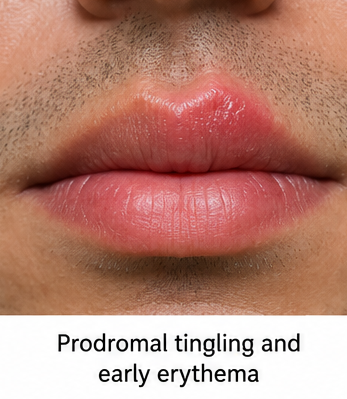
Over the next two days, the lesions increased in number and became painful, particularly during eating, drinking, and speaking.
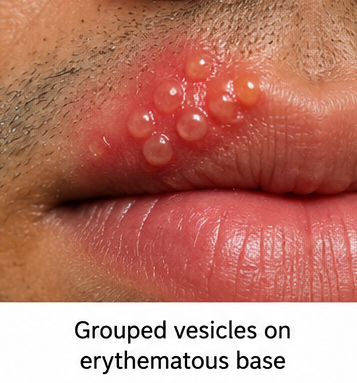
Some vesicles subsequently ruptured, resulting in superficial erosions and crust formation.
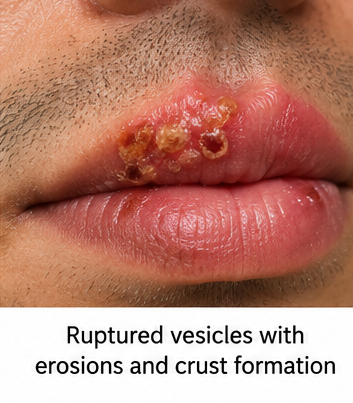
The patient reported experiencing two similar episodes during the preceding year, both resolving spontaneously within approximately one week.
He also reported considerable occupational stress and a recent episode of mild febrile illness before the onset of the current lesions.
There was no history of significant trauma, recent dental procedures, genital lesions, or known contact with individuals experiencing active herpes infection.
The patient had no known history of diabetes mellitus, immunosuppression, or chronic dermatological disease.
On examination, the patient was conscious, alert, and hemodynamically stable.
Clinical findings included:
- Temperature: 37.1°C
- Heart rate: 82 beats/minute
- Blood pressure: 122/80 mmHg
- Oxygen saturation: 99% on room air
- Multiple grouped vesicles over the upper lip and vermilion border
- Several superficial erosions with yellowish-brown crust formation
- Mild surrounding erythema and localized swelling
- Tenderness over the affected areas
- Mild discomfort during oral intake
The largest cluster measured approximately 1.5 cm in diameter and was located near the right upper lip.
Several vesicles contained clear fluid, while others had ruptured, producing shallow erosions.
There was no significant purulent discharge, extensive facial swelling, or intraoral ulceration.
Mild tenderness of the submandibular lymph nodes was observed without significant lymphadenopathy.
The characteristic grouped vesicular lesions, preceding burning sensation, and history of recurrent episodes raised suspicion of herpes simplex labialis.
Investigations
The initial diagnosis was based on clinical examination and the characteristic recurrent presentation.
A swab specimen was collected from the base of a freshly unroofed vesicle for HSV PCR testing.
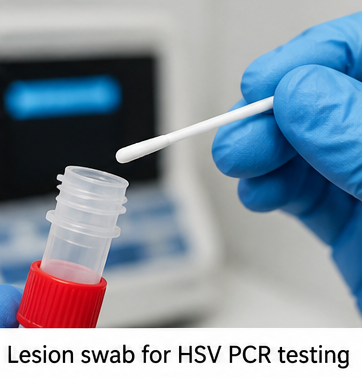
Laboratory investigations revealed:
- Hemoglobin: 14.2 g/dL
- White blood cell count: 7,600 cells/µL
- Platelet count: 258,000 cells/µL
- Erythrocyte sedimentation rate: 14 mm/hour
- C-reactive protein: 4 mg/L
- Fasting blood glucose: 94 mg/dL
Routine renal and liver function tests were within normal limits.
HSV PCR testing of the lesion specimen was positive for HSV-1 DNA.
HSV-2 DNA was not detected.
No evidence of significant secondary bacterial infection was identified.
Additional investigations for systemic infection or immunodeficiency were not considered necessary based on the patient's clinical presentation and medical history.
Based on the characteristic vesicular lesions, recurrent episodes, prodromal symptoms, and positive HSV-1 PCR findings, a diagnosis of recurrent herpes simplex labialis was established.
Differential Diagnosis
Impetigo
Impetigo is a superficial bacterial skin infection that may produce vesicles, pustules, and characteristic honey-colored crusts.
However, the preceding tingling sensation, grouped vesicular lesions, recurrent episodes, and positive HSV-1 PCR favored herpes simplex infection.
Aphthous Stomatitis
Aphthous ulcers commonly present as painful, shallow ulcers involving the nonkeratinized oral mucosa.
The predominantly external lip involvement and initial vesicular eruption were inconsistent with typical aphthous stomatitis.
Herpes Zoster
Herpes zoster results from reactivation of varicella-zoster virus and usually produces a painful, unilateral vesicular eruption following a dermatomal distribution.
The localized recurrent lesions and positive HSV-1 PCR supported herpes simplex rather than herpes zoster.
Allergic Contact Cheilitis
Allergic contact cheilitis may cause erythema, swelling, scaling, and discomfort involving the lips.
However, the presence of grouped fluid-filled vesicles and recurrent prodromal symptoms was more suggestive of HSV infection.
Hand, Foot, and Mouth Disease
Hand, foot, and mouth disease may produce oral vesicles and ulcerations, commonly accompanied by lesions on the hands and feet.
The absence of characteristic acral lesions and the positive HSV-1 PCR findings made this diagnosis unlikely.
Management and Outcome
The patient was managed under dermatological supervision.
Oral valacyclovir was prescribed at a dose of 2 g every 12 hours for one day, consistent with an established episodic treatment regimen for recurrent herpes labialis in adults with normal renal function.
Because treatment was initiated approximately four days after symptom onset, the patient was informed that the benefit of antiviral therapy might be limited compared with treatment started during the prodromal phase.
Paracetamol was prescribed as needed for pain and discomfort.
The patient was advised to maintain adequate hydration and avoid foods that aggravated the affected areas.
Gentle cleansing of the lesions was recommended, and the patient was instructed to avoid picking or removing crusts.
Systemic antibiotics were not prescribed because there was no clinical evidence of secondary bacterial infection.
The patient was educated regarding the contagious nature of HSV infection and advised to avoid kissing, oral sexual contact, and sharing lip products during active lesions.
He was also advised to practice regular hand hygiene and avoid touching the eyes after contact with the lesions.
At the one-week follow-up, the patient reported considerable reduction in pain and burning sensation.
Most vesicles had resolved, and the remaining erosions demonstrated satisfactory healing.
At approximately two weeks, the lesions had completely healed without scarring or evidence of secondary infection.
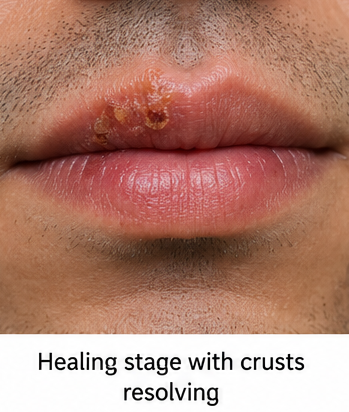
At the four-week follow-up, no new lesions were observed.
The patient was counseled regarding early recognition of prodromal symptoms and the importance of initiating episodic antiviral treatment promptly during future recurrences.
Preventive advice included minimizing known triggers, managing stress, and using lip protection during prolonged sun exposure.
Suppressive antiviral therapy was discussed as a possible option if future episodes became frequent or significantly affected quality of life.
Discussion
Herpes simplex virus infection is among the most common viral infections affecting the skin and mucous membranes.
HSV-1 is predominantly associated with orolabial herpes, although both HSV-1 and HSV-2 can produce infections at different anatomical sites.
Transmission occurs primarily through direct contact with infected skin, mucosal surfaces, saliva, or other infectious secretions.
Following primary infection, HSV travels through sensory nerve fibers and establishes latency within sensory ganglia.
In orolabial herpes, viral latency commonly occurs within the trigeminal ganglion.
Periodic reactivation results in viral replication and migration toward the skin or mucosal surfaces, producing recurrent lesions.
Reactivation may be triggered by fever, ultraviolet radiation, emotional stress, local trauma, or changes in immune function.
Recurrent herpes labialis commonly begins with a prodromal phase characterized by tingling, itching, burning, or localized discomfort.
Within hours, grouped vesicles typically develop over an erythematous base, frequently involving the vermilion border of the lips.
These vesicles subsequently rupture, producing superficial erosions followed by crust formation.
In immunocompetent individuals, uncomplicated recurrent episodes generally resolve spontaneously within approximately 7–14 days.
In the present case, the characteristic prodromal burning sensation, recurrent grouped vesicles, and positive HSV-1 PCR findings supported the diagnosis.
Although clinical examination is frequently sufficient in typical presentations, laboratory confirmation may be useful when the diagnosis is uncertain or lesions have atypical features.
PCR testing is a sensitive method for detecting HSV DNA from active lesions and can distinguish between HSV-1 and HSV-2.
Viral culture may also establish the diagnosis, although sensitivity decreases as lesions begin to heal.
HSV serological testing can demonstrate previous exposure but generally cannot determine whether an active oral lesion is caused by HSV.
Treatment focuses on reducing symptom duration, promoting healing, minimizing complications, and managing recurrent episodes.
Oral antiviral medications such as acyclovir, valacyclovir, and famciclovir inhibit viral DNA replication.
These agents are most effective when initiated during the prodromal phase or shortly after lesion onset.
For recurrent herpes labialis, high-dose, short-duration valacyclovir treatment is an established therapeutic option in appropriate adult patients.
However, antiviral treatment does not eliminate latent HSV from sensory ganglia, and future reactivation remains possible.
In the present case, the lesions resolved without complications following antiviral treatment and supportive care. Because recurrent herpes labialis is often self-limiting, recovery cannot be attributed exclusively to the antiviral medication.
Suppressive antiviral therapy may be considered in patients experiencing frequent, severe, or troublesome recurrences.
Potential complications include secondary bacterial infection, extensive mucocutaneous involvement, and ocular HSV infection.
Herpetic keratitis is a particularly important complication because untreated ocular involvement can threaten vision.
Individuals with immunosuppression may experience more extensive, persistent, or severe HSV infections.
Preventive strategies include avoiding direct contact with active lesions, practicing hand hygiene, limiting exposure to recognized triggers, and using appropriate barrier precautions.
Patients should also be informed that asymptomatic viral shedding can occur, allowing transmission even when visible lesions are absent.
Early recognition and appropriate management can reduce symptom burden and improve quality of life among individuals with recurrent herpes simplex infection.
Conclusion
Herpes simplex labialis is a common recurrent viral infection predominantly associated with HSV-1.
Painful grouped vesicles over the lips, preceded by tingling or burning sensations, are characteristic clinical findings.
A history of similar episodes provides an important diagnostic clue.
Clinical examination is often sufficient for diagnosis, while PCR testing provides laboratory confirmation and viral typing when required.
Oral antiviral therapy may shorten symptom duration when initiated early, although it does not eradicate latent infection.
Patient education regarding transmission, recurrence triggers, and early treatment is essential for long-term management.
This illustrative case emphasizes the importance of recognizing recurrent herpes simplex infection, confirming the diagnosis when appropriate, and providing timely treatment and preventive counseling.
References
1. Arduino PG, Porter SR. Herpes Simplex Virus Type 1 infection: overview on relevant clinico-pathological features. Journal of Oral Pathology & Medicine. 2008;37(2):107–121. https://doi.org/10.1111/j.1600-0714.2007.00586.x
2. Whitley RJ, Roizman B. Herpes simplex viruses. The Lancet. 2001;357(9267):1513–1518. https://doi.org/10.1016/S0140-6736(00)04638-9
3. Spruance SL, Jones TM, Blatter MM, et al. High-dose, short-duration, early valacyclovir therapy for episodic treatment of cold sores: results of two randomized, placebo-controlled, multicenter studies. Antimicrobial Agents and Chemotherapy. 2003;47(3):1072–1080. https://doi.org/10.1128/AAC.47.3.1072-1080.2003
4. Fatahzadeh M, Schwartz RA. Human herpes simplex virus infections: epidemiology, pathogenesis, symptomatology, diagnosis, and management. Journal of the American Academy of Dermatology. 2007;57(5):737–763. https://doi.org/10.1016/j.jaad.2007.06.027
5. World Health Organization. Herpes simplex virus. Fact sheet. https://www.who.int/news-room/fact-sheets/detail/herpes-simplex-virus
Read more such content on @ Hidoc Dr | Medical Learning App for Doctors
Recommended News For You
Recommended Articles For You
Featured News
Featured Articles
Featured Events
Featured KOL Videos
1.
Marstacimab Gets FDA Nod for Hemophilia A or B Without Inhibitors
2.
In breast-conserving surgery, is micro-CT a useful tool for determining tumor margins?
3.
Sub-Q Ketamine is Safe and Very Effective for Severe Depression.
4.
For older patients with Hodgkin lymphoma, novel regimens produce high response rates.
5.
FDA Approves First CELMoD Drug for Multiple Myeloma
1.
Intelligent Hematopoietic Cell-State Mapping: Transforming Diagnostic Precision and Clinical Decision-Making
2.
Teaching Hematology Through Morphology-Based Learning
3.
Neutrophil Extracellular Traps in Hematologic Disorders
4.
Optimizing Erythropoietic Health to Prevent Age-Related Hematologic Decline
5.
Prognostic Patterns of Functional Recovery During Long-Term Cancer Survivorship
1.
International Conference on Innovations in Critical Care for Oncology and Cardiology
2.
International Conference on Oncology, Cardiology and Critical Care Policy
3.
International Conference on Oncology, Cancer Prevention and Public Health
4.
International Conference on Cancer Nursing and Rehabilitation Strategies
5.
International Conference on Best Practices in Oncology, Cardiology and Critical Care

Address :
Hidoc Dr. Inc. | Delaware C Corp | 1309 Coffeen Ave. Suite 1200, Sheridan WY, 82801
Phone :
+1-415-463-3094
Email :
anishagadia@hidoc.co
© Copyright 2026 Hidoc Dr. Inc.
Terms & Conditions - LLP | Inc. | Privacy Policy - LLP | Inc. | Account Deactivation

To get started please enter your email ID
Welcome to Hidoc Dr.
Join to enhance your clinical skills and gain specialized in-depth medical knowledge