Corneal Burn Following Chemical Exposure Presenting With Ocular Pain and Reduced Vision: A Case Report
OthersPage Navigation
Abstract
Corneal burns are ophthalmic emergencies that may result from exposure to chemical or thermal agents and can rapidly lead to vision-threatening complications if not treated promptly. Chemical burns, particularly alkali injuries, penetrate ocular tissues rapidly and may cause extensive damage to the corneal epithelium, limbal stem cells, and anterior segment structures. Immediate irrigation followed by comprehensive ophthalmic evaluation is essential to minimize permanent visual impairment. We report the case of a 32-year-old male factory worker who presented after accidental chemical exposure to the right eye while handling industrial cleaning agents. He developed severe ocular pain, redness, excessive tearing, photophobia, and blurred vision. Examination revealed a moderate corneal epithelial defect with conjunctival congestion consistent with a Grade II chemical corneal burn. The patient underwent immediate copious ocular irrigation, topical antibiotics, lubricants, cycloplegics, corticosteroids, vitamin C supplementation, and close ophthalmic follow-up. Progressive epithelial healing occurred without infection or corneal perforation, and visual acuity improved significantly over six weeks. This case highlights the importance of early recognition, prompt irrigation, timely medical management, and structured follow-up in achieving favorable visual outcomes after corneal burns.
Introduction
Corneal burns are vision-threatening ocular emergencies caused by chemical, thermal, electrical, or radiation injuries. Among these, chemical burns are the most common and potentially devastating because of their ability to penetrate the cornea rapidly and damage deeper ocular tissues.
Alkali substances, including lime, ammonia, and industrial cleaning agents, penetrate ocular tissues more rapidly than acids by causing saponification of cell membranes and collagen degradation. Acid burns generally produce coagulation necrosis that limits deeper penetration but may still result in significant ocular morbidity.
Clinical manifestations include severe ocular pain, conjunctival redness, excessive lacrimation, photophobia, foreign body sensation, blepharospasm, decreased visual acuity, and corneal epithelial defects. Severe injuries may involve limbal stem cell deficiency, corneal ulceration, stromal melting, glaucoma, cataract formation, and permanent visual loss.
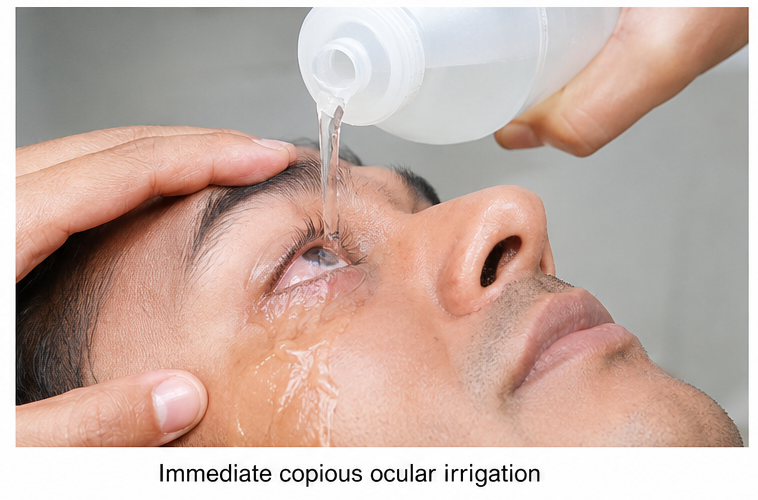
Immediate copious irrigation is the cornerstone of management and should begin as soon as possible, even before ophthalmologic evaluation. Treatment focuses on restoration of the ocular surface, prevention of infection, suppression of inflammation, promotion of epithelial healing, and long-term preservation of vision.
We report a case of a moderate chemical corneal burn successfully managed with prompt medical therapy and close ophthalmic follow-up.
Case Report
A 32-year-old male factory worker presented to the emergency department approximately one hour after accidental splashing of an industrial alkaline cleaning solution into his right eye while cleaning machinery. The patient was not wearing protective goggles at the time of injury.
Immediately following exposure, he experienced severe burning pain, redness, profuse tearing, photophobia, and progressive blurring of vision. Initial irrigation had not been performed before arrival at the hospital.
He denied previous ocular disease, contact lens use, or prior ocular surgery. His medical history was otherwise unremarkable.
On examination, visual acuity measured 6/24 in the right eye and 6/6 in the left eye. The right eye demonstrated marked conjunctival hyperemia, eyelid edema, excessive lacrimation, and blepharospasm.
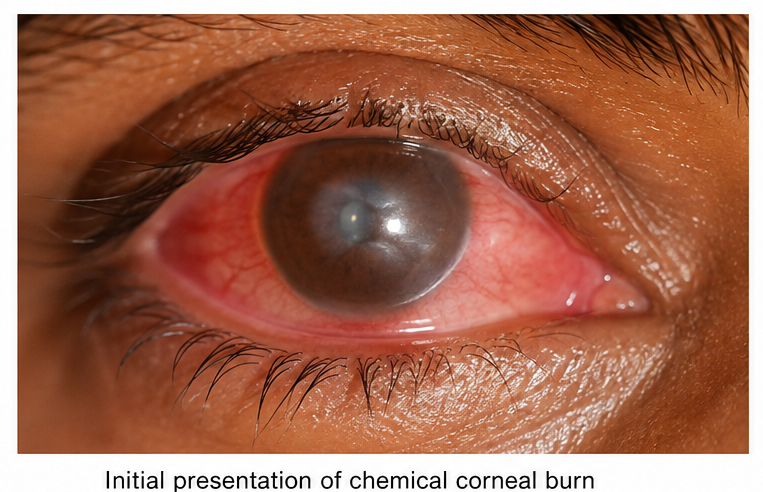
Slit-lamp examination revealed a large corneal epithelial defect involving the central cornea with stromal haze but no perforation. Fluorescein staining confirmed epithelial loss.
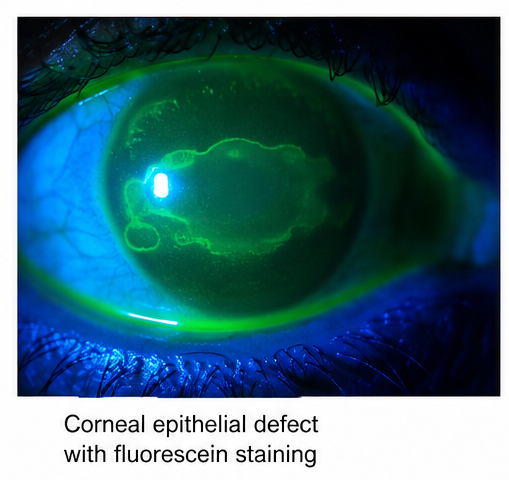
Mild limbal ischemia involving less than one-third of the limbus was present, consistent with a Grade II chemical burn according to the Roper-Hall classification. The anterior chamber remained quiet, and intraocular pressure was within normal limits.
Following ocular irrigation until physiologic pH was achieved, the patient was diagnosed with a moderate alkali-induced corneal burn of the right eye.
Management and Outcome
Immediate management consisted of continuous ocular irrigation with balanced saline solution until conjunctival pH normalized.
Medical treatment included:
- Topical broad-spectrum antibiotic eye drops
- Preservative-free artificial tears
- Cycloplegic eye drops for pain relief
- Short-course topical corticosteroids
- Oral vitamin C supplementation
- Lubricating ointment during nighttime
- Protective eye shield and avoidance of eye rubbing
The patient underwent frequent ophthalmic reviews to monitor epithelial healing, corneal clarity, intraocular pressure, and signs of infection.
Progressive epithelial regeneration occurred without stromal ulceration or corneal perforation. No secondary glaucoma or infectious keratitis developed.
Follow-up
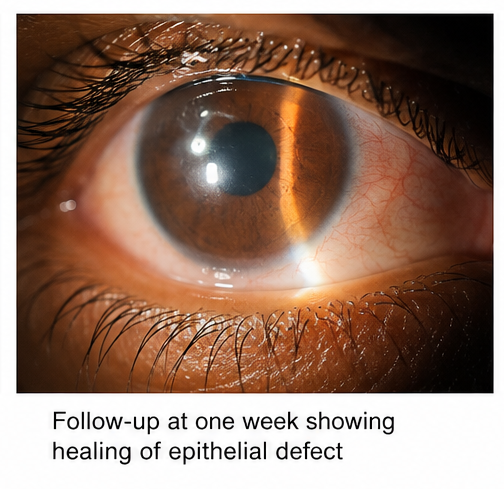
One Week
- Significant reduction in ocular pain and photophobia
- Corneal epithelial defect markedly reduced
- Conjunctival congestion improved
- Visual acuity improved to 6/18
- No evidence of infection
One Month
- Complete epithelial healing achieved
- Corneal clarity significantly improved
- Minimal residual stromal haze
- Visual acuity improved to 6/9
- Lubricating therapy continued
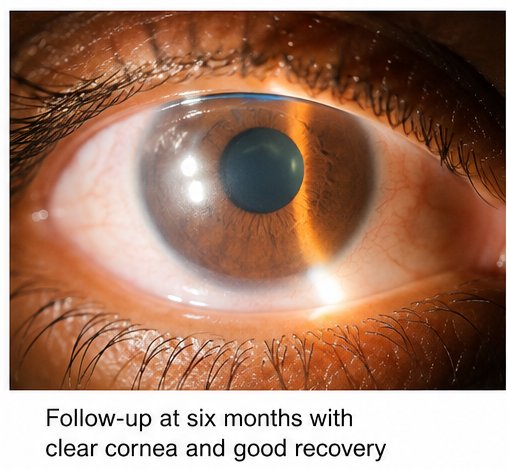
Six Months
- Stable ocular surface
- Mild residual peripheral corneal scar
- Best corrected visual acuity reached 6/6
- No limbal stem cell deficiency
- No recurrent epithelial defects observed
Discussion
Corneal burns represent true ophthalmic emergencies requiring immediate intervention. The extent of ocular damage depends upon the chemical involved, duration of exposure, concentration, and time elapsed before irrigation.
Alkali injuries generally produce more severe damage than acid burns because hydroxyl ions rapidly penetrate ocular tissues, resulting in collagen degradation, inflammatory mediator release, and limbal stem cell injury.
Prompt irrigation remains the single most important determinant of prognosis and should never be delayed while awaiting specialist consultation. Irrigation should continue until ocular surface pH returns to normal.
Classification systems such as the Roper-Hall grading system help determine prognosis and guide treatment strategies. Mild to moderate injuries usually respond well to conservative medical management, whereas severe burns may require amniotic membrane transplantation, limbal stem cell transplantation, or corneal transplantation.
Medical therapy aims to suppress inflammation, prevent infection, promote epithelial regeneration, reduce stromal collagen breakdown, and preserve limbal stem cell function.
Close follow-up is essential because delayed complications including persistent epithelial defects, corneal ulceration, stromal melting, glaucoma, cataract formation, dry eye disease, and limbal stem cell deficiency may develop even after apparent initial recovery.
This case demonstrates that immediate irrigation, early medical treatment, and structured follow-up can achieve excellent visual outcomes following moderate chemical corneal burns.
Prognosis
Visual prognosis following corneal burns depends on the severity of the initial injury, extent of limbal ischemia, rapidity of irrigation, and development of secondary complications.
Patients with mild to moderate chemical burns generally recover good visual acuity with prompt treatment. Severe injuries involving extensive limbal stem cell loss, stromal necrosis, or corneal perforation carry a poorer prognosis and may require complex ocular surface reconstruction.
Long-term follow-up is recommended to monitor corneal transparency, ocular surface stability, intraocular pressure, and visual rehabilitation.
Conclusion
Corneal burns constitute vision-threatening emergencies that require immediate ocular irrigation and prompt ophthalmic management. Early diagnosis, rapid restoration of ocular surface integrity, aggressive medical therapy, and careful follow-up are essential for preventing permanent visual impairment.
This case illustrates the successful management of a moderate alkali-induced corneal burn through timely irrigation, comprehensive medical treatment, and structured follow-up, resulting in complete epithelial healing and excellent visual recovery.
References
- Wagoner MD. Chemical injuries of the eye: current concepts in pathophysiology and therapy. Surv Ophthalmol. 1997;41(4):275-313. https://pubmed.ncbi.nlm.nih.gov/9104767/
- Dua HS, King AJ, Joseph A. A new classification of ocular surface burns. Br J Ophthalmol. 2001;85(11):1379-1383. https://pubmed.ncbi.nlm.nih.gov/11673298/
- Sharma N, Kaur M, Agarwal T, Sangwan VS, Vajpayee RB. Treatment of acute ocular chemical burns. Surv Ophthalmol. 2018;63(2):214-235. https://pubmed.ncbi.nlm.nih.gov/28935121/
- American Academy of Ophthalmology (AAO). Chemical Injury of the Cornea and Conjunctiva. https://www.aao.org/education/disease-review/chemical-injury-of-cornea-conjunctiva
- Singh P, Tyagi M, Kumar Y, Gupta KK, Sharma PD. Ocular chemical injuries and their management. Oman J Ophthalmol. 2013;6(2):83-86. https://pubmed.ncbi.nlm.nih.gov/24082630/
- Bizrah M, Yusuf A, Ahmad S, et al. An update on chemical eye burns. Eye (Lond). 2019;33(9):1362-1377. https://pubmed.ncbi.nlm.nih.gov/31086244/
- Dua HS, Ting DSJ, Al Saadi A, Said DG. Chemical eye injury: pathophysiology, assessment and management. Eye (Lond). 2020;34(11):2001-2019. https://pubmed.ncbi.nlm.nih.gov/32572184/
Read more such content on @ Hidoc Dr | Medical Learning App for Doctors
Recommended News For You
Recommended Articles For You
Featured News
Featured Articles
Featured Events
Featured KOL Videos
1.
Study suggests exercise could reduce breast cancer recurrence
2.
Dense breasts: What it means and what women can do about screening
3.
Exercise may help breast cancer survivors manage weight
4.
For patients with prostate cancer, long-term follow-up helps identify treatment side effects.
5.
New CAR T-Cell Therapy Approved for Leukemia
1.
Evolutionary Bottlenecks in Tumor Progression
2.
PARP Inhibitors in Testicular Cancer: Tackling Cisplatin Resistance with Precision
3.
Understanding Vaso Occlusive Crisis: Symptoms, Causes, and Management Strategies
4.
Studying Lactic Acid in Pediatric Tumor Microenvironments: Experimental Approaches Explored
5.
Uncovering the Mysteries of Breast Cancer: The Journey to a Cure
1.
Asian Symposium on Advancement in Hematology and Oncology (ASAHO)
2.
International Cancer Conference
3.
Asian Symposium on Advancement in Hematology and Oncology (ASAHO)
4.
Asian Symposium on Advancement in Hematology and Oncology
5.
Asian Symposium on Advancement in Hematology and Oncology
1.
Preventing Blood Clots: The Importance of Venous Thromboembolism Management
2.
Navigating the Complexities of Ph Negative ALL - Part III
3.
An Eagles View - Evidence-based Discussion on Iron Deficiency Anemia- Panel Discussion IV
4.
A Comprehensive Guide to First Line Management of ALK Positive Lung Cancer - Part VIII
5.
Breaking Ground: ALK-Positive Lung Cancer Front-Line Management - Part II

Address :
Hidoc Dr. Inc. | Delaware C Corp | 1309 Coffeen Ave. Suite 1200, Sheridan WY, 82801
Phone :
+1-415-463-3094
Email :
anishagadia@hidoc.co
© Copyright 2026 Hidoc Dr. Inc.
Terms & Conditions - LLP | Inc. | Privacy Policy - LLP | Inc. | Account Deactivation

To get started please enter your email ID
Welcome to Hidoc Dr.
Join to enhance your clinical skills and gain specialized in-depth medical knowledge