Pernicious Anaemia: A Case Report of Severe Vitamin B12 Deficiency and Neurological Manifestations
OthersPage Navigation
Abstract
Pernicious anaemia is an autoimmune disorder in which reduced intrinsic factor production or activity impairs intestinal vitamin B12 absorption. It is commonly associated with autoimmune atrophic gastritis and may cause haematological, gastrointestinal, neurological, and neuropsychiatric manifestations. [1,2]
We describe a representative case of a 46-year-old woman who presented with progressive fatigue, exertional breathlessness, palpitations, distal paraesthesia, gait unsteadiness, and a painful tongue. Examination revealed marked pallor, mild scleral icterus, atrophic glossitis, and impaired vibration and position sense in the lower limbs.
Investigations demonstrated severe macrocytic anaemia, leukopenia, thrombocytopenia, hypersegmented neutrophils, low serum vitamin B12, and elevated methylmalonic acid and homocysteine. Positive anti-intrinsic factor antibodies and gastric parietal cell antibodies supported the diagnosis of pernicious anaemia. The patient received parenteral vitamin B12 followed by lifelong maintenance therapy. Haematological parameters improved promptly, while neurological symptoms recovered gradually.
This case highlights the importance of considering pernicious anaemia in patients with macrocytosis, unexplained cytopenias, glossitis, or neurological symptoms.
Introduction
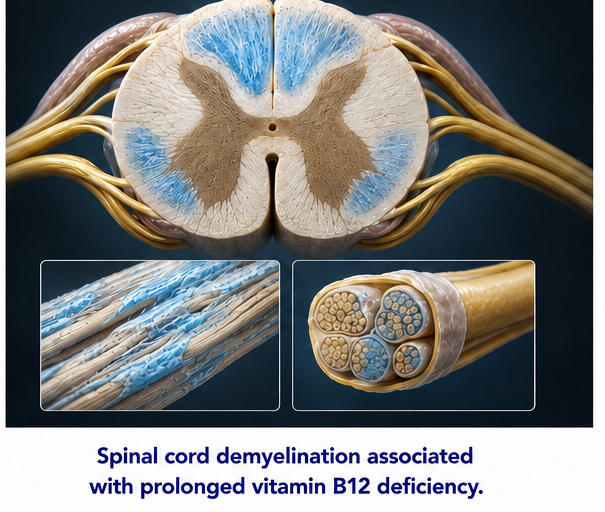
Vitamin B12 is essential for DNA synthesis, red blood cell production, and neurological function. Deficiency impairs haematopoiesis and myelin maintenance, resulting in megaloblastic anaemia and neurological dysfunction. [1,3]
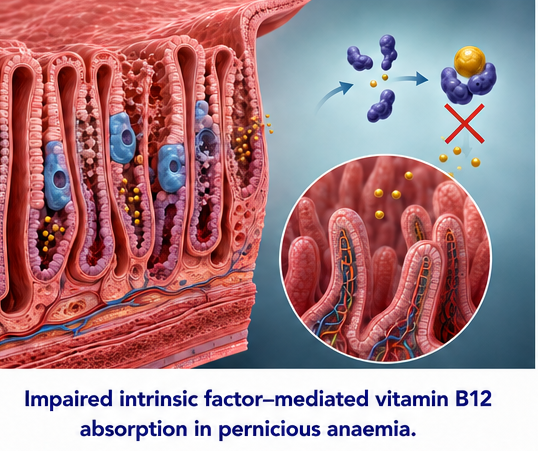
In pernicious anaemia, autoimmune destruction of gastric parietal cells reduces intrinsic factor production. Anti-intrinsic factor antibodies may also prevent vitamin B12 from binding to intrinsic factor or interfere with absorption of the complex in the terminal ileum. [1,2]
The condition usually develops gradually because hepatic vitamin B12 stores may last for several years. Early diagnosis is important because haematological abnormalities generally respond well to treatment, whereas prolonged neurological injury may be incompletely reversible.
Case Report
A 46-year-old woman presented with progressive fatigue, generalized weakness, exertional breathlessness, and intermittent palpitations for four months. During the preceding six weeks, she had developed numbness and tingling in both feet, gait unsteadiness, reduced appetite, and tongue discomfort.
She followed a mixed diet and had no history of gastrointestinal surgery, chronic diarrhoea, inflammatory bowel disease, alcohol misuse, or overt blood loss. Her medical history included autoimmune thyroid disease.
On examination, she had marked pallor, mild scleral icterus, tachycardia, and a smooth, erythematous tongue. Neurological examination demonstrated reduced vibration sense, impaired joint-position sense in the toes, distal sensory loss, and difficulty with tandem walking. Muscle strength was preserved.
Investigations
Complete blood count demonstrated:
-
Haemoglobin: 7.2 g/dL
-
Mean corpuscular volume: 118 fL
-
Total leukocyte count: 3,200 cells/mm³
-
Platelet count: 112,000/mm³
-
Inappropriately low reticulocyte count
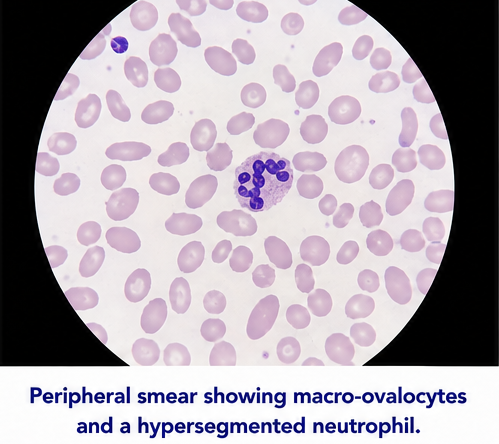
Peripheral blood smear showed macro-ovalocytes, anisopoikilocytosis, and hypersegmented neutrophils.
Additional investigations revealed:
-
Serum vitamin B12: 78 pg/mL
-
Normal serum folate
-
Elevated methylmalonic acid and homocysteine
-
Markedly elevated lactate dehydrogenase
-
Mildly elevated indirect bilirubin
-
Positive anti-intrinsic factor antibodies
-
Positive gastric parietal cell antibodies
Upper gastrointestinal endoscopy and gastric biopsy demonstrated changes consistent with autoimmune atrophic gastritis.

Diagnosis
The diagnosis was based on:
-
Severe macrocytic anaemia with leukopenia and thrombocytopenia
-
Atrophic glossitis and neurological manifestations
-
Markedly reduced serum vitamin B12
-
Elevated methylmalonic acid and homocysteine
-
Positive anti-intrinsic factor and gastric parietal cell antibodies
-
Evidence of autoimmune atrophic gastritis
The overall findings confirmed pernicious anaemia caused by autoimmune impairment of vitamin B12 absorption.
Differential Diagnosis
The principal differential diagnoses included:
-
Dietary vitamin B12 deficiency
-
Folate deficiency
-
Coeliac disease or inflammatory bowel disease
-
Medication-related vitamin B12 malabsorption
-
Myelodysplastic syndrome
-
Hypothyroidism
-
Chronic liver disease
-
Haemolytic anaemia
-
Thrombotic microangiopathy
The positive anti-intrinsic factor antibodies and autoimmune gastric changes strongly supported pernicious anaemia.
Management and Outcome
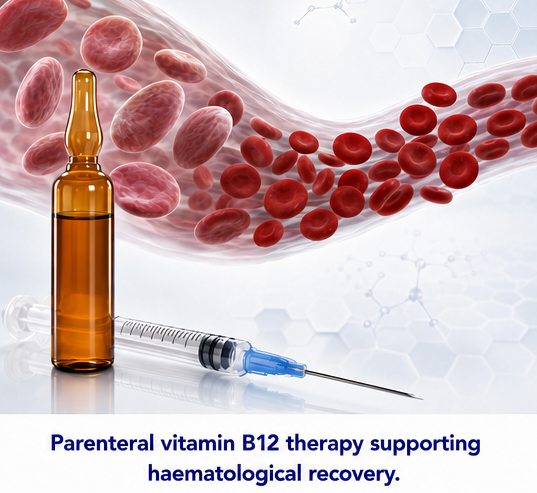
Parenteral vitamin B12 replacement was initiated because the patient had severe anaemia and neurological manifestations. An initial intramuscular loading course was followed by lifelong maintenance treatment.
Supportive management included monitoring of blood counts, serum potassium, iron status, and neurological findings. The patient was also evaluated for associated autoimmune disorders and referred for gastroenterological follow-up.
Within the first week, appetite, palpitations, and general well-being improved. A reticulocyte response indicated recovery of effective erythropoiesis.
During subsequent weeks, haemoglobin increased, leukocyte and platelet counts improved, and lactate dehydrogenase and indirect bilirubin declined. Glossitis resolved, while paraesthesia and gait disturbance improved more gradually.
Follow-up
Early Follow-up
-
Improved appetite and energy
-
Reduced palpitations and breathlessness
-
Appropriate reticulocyte response
-
Decreased lactate dehydrogenase
-
No progression of neurological deficits
Subsequent Follow-up
-
Progressive increase in haemoglobin
-
Recovery of leukocyte and platelet counts
-
Resolution of glossitis and scleral icterus
-
Gradual reduction in paraesthesia
-
Improved balance and gait
Later Follow-up
-
Maintenance of haematological recovery
-
Continued neurological improvement
-
Lifelong vitamin B12 replacement
-
Periodic assessment of iron status
-
Follow-up for autoimmune atrophic gastritis
Discussion
Pernicious anaemia is caused by autoimmune impairment of intrinsic factor-mediated vitamin B12 absorption. It is commonly associated with autoimmune atrophic gastritis, which results in loss of gastric parietal cells and reduced secretion of intrinsic factor. [1,2]
Vitamin B12 deficiency disrupts DNA synthesis in rapidly dividing bone marrow cells. This causes ineffective erythropoiesis, macro-ovalocytosis, and hypersegmented neutrophils. Severe disease can affect multiple bone marrow cell lines, resulting in leukopenia and thrombocytopenia.
Intramedullary destruction of abnormal erythroid precursors may cause marked elevation of lactate dehydrogenase and indirect bilirubin. This biochemical pattern can resemble haemolytic anaemia or thrombotic microangiopathy. [3,5]
Neurological manifestations include paraesthesia, sensory loss, impaired vibration and position sense, gait disturbance, cognitive changes, and subacute combined degeneration of the spinal cord. These manifestations can occur even without severe anaemia or obvious macrocytosis. [1,4]
Low serum vitamin B12 supports the diagnosis. Methylmalonic acid and homocysteine are useful when the serum vitamin B12 result is borderline or inconsistent with the clinical presentation.
Anti-intrinsic factor antibodies are highly specific for pernicious anaemia, but a negative result does not exclude the condition. Gastric parietal cell antibodies are more sensitive but less specific. [1,2]
Treatment consists of vitamin B12 replacement. Parenteral therapy is commonly preferred initially in severe anaemia or neurological involvement. Because intrinsic factor deficiency usually persists, treatment is generally lifelong.
Patients should also be monitored for iron deficiency, associated autoimmune diseases, and complications of autoimmune atrophic gastritis. Gastroenterological surveillance should be individualized because autoimmune gastritis is associated with an increased risk of gastric neoplasia.
Prognosis
The prognosis is generally favourable when pernicious anaemia is diagnosed and treated promptly. Haematological abnormalities typically improve within weeks.
Neurological recovery may require several months and depends on the severity and duration of deficiency. Long-standing neurological injury may remain incomplete despite normalization of vitamin B12 and haemoglobin levels.
Conclusion
Pernicious anaemia is an autoimmune cause of vitamin B12 malabsorption that may produce severe haematological and neurological manifestations.
The diagnosis should be considered in patients with macrocytosis, unexplained cytopenias, glossitis, paraesthesia, or gait disturbance. Low vitamin B12, elevated methylmalonic acid or homocysteine, and positive anti-intrinsic factor antibodies support the diagnosis.
Prompt vitamin B12 replacement can correct the haematological abnormalities and prevent progression of neurological damage. Lifelong treatment and appropriate follow-up are required because intrinsic factor deficiency is generally permanent.
References
-
Vaqar S, Shackelford KB. Pernicious Anemia. StatPearls. StatPearls Publishing; updated 2023. https://www.ncbi.nlm.nih.gov/books/NBK540989/
-
Htut TW, Thein KZ, Oo TH. Pernicious anemia: Pathophysiology and diagnostic difficulties. Journal of Evidence-Based Medicine. 2021;14(2):161–169. https://pubmed.ncbi.nlm.nih.gov/34015185/
-
Jajoo SS, Zamwar UM, Taksande AB, et al. Etiology, clinical manifestations, diagnosis, and treatment of cobalamin deficiency. Cureus. 2024. https://pubmed.ncbi.nlm.nih.gov/38344487/
-
Shrestha SR, Shrestha A, Karn R, et al. Rare case of pernicious anaemia from a university hospital of Nepal. Annals of Medicine and Surgery. 2022. https://pmc.ncbi.nlm.nih.gov/articles/PMC9422178/
-
Romero KN, Leung J, Kudaravalli P, et al. A case of pernicious anemia presenting with severe hemolysis. Journal of Investigative Medicine High Impact Case Reports. 2023. https://pmc.ncbi.nlm.nih.gov/articles/PMC10788660/
Read more such content on @ Hidoc Dr | Medical Learning App for Doctors
Recommended News For You
Recommended Articles For You
Featured News
Featured Articles
Featured Events
Featured KOL Videos
1.
The need for more Latinx participants in Alzheimer's trials is urgent.
2.
Study reveals crucial gaps in oral cancer awareness in Middle East and North Africa
3.
Disparities in use of MRI to detect prostate cancer: Race and location may influence testing
4.
In breast-conserving surgery, is micro-CT a useful tool for determining tumor margins?
5.
Study offers clearer picture of childhood brain tumor survival
1.
Revolutionizing Cancer Care: The Promise of Early Detection and Biomarkers
2.
The Oncologist’s Edge: Tools, Trials, and Tech Transforming Treatment
3.
Comprehensive Standards in Oncology for Modern Medicine
4.
Cardio-Oncology: Managing Heart Failure in Survivors of Cancer
5.
Practical Standards in Hematology for Healthcare Excellence
1.
Asian Symposium on Advancement in Hematology and Oncology (ASAHO)
2.
International Cancer Conference
3.
Asian Symposium on Advancement in Hematology and Oncology (ASAHO)
4.
Asian Symposium on Advancement in Hematology and Oncology
5.
Asian Symposium on Advancement in Hematology and Oncology
1.
Targeting Oncologic Drivers with Dacomitinib: A New Approach to Lung Cancer Treatment
2.
Revolutionizing Treatment of ALK Rearranged NSCLC with Lorlatinib - Part II
3.
Efficient Management of First line ALK-rearranged NSCLC - Part VIII
4.
Nimotozumab Plus Chemo-radiotherapy v/s Placebo Plus Chemo-radiotherapy in Locally Advanced Nasopharyngeal Carcinoma
5.
Breaking Ground: ALK-Positive Lung Cancer Front-Line Management - Part V

Address :
Hidoc Dr. Inc. | Delaware C Corp | 1309 Coffeen Ave. Suite 1200, Sheridan WY, 82801
Phone :
+1-415-463-3094
Email :
anishagadia@hidoc.co
© Copyright 2026 Hidoc Dr. Inc.
Terms & Conditions - LLP | Inc. | Privacy Policy - LLP | Inc. | Account Deactivation

To get started please enter your email ID
Welcome to Hidoc Dr.
Join to enhance your clinical skills and gain specialized in-depth medical knowledge