Squamous Cell Carcinoma of the Left Tonsil Presenting with Progressive Dysphagia and Neck Swelling: A Case Report
ENTPage Navigation
Abstract
Squamous cell carcinoma of the tonsil is a common malignancy of the oropharynx and may present with nonspecific symptoms, resulting in delayed diagnosis. Human papillomavirus (HPV), particularly HPV-16, has emerged as an important etiological factor in a substantial proportion of oropharyngeal squamous cell carcinomas, although tobacco and alcohol exposure remain important risk factors. We report the case of a 56-year-old male who presented with progressive left-sided throat discomfort, difficulty swallowing, referred left ear pain, and a gradually enlarging left neck swelling. Clinical examination revealed an ulceroproliferative lesion involving the left palatine tonsil with an ipsilateral cervical lymph node. Contrast-enhanced imaging demonstrated a left tonsillar mass with regional cervical lymphadenopathy. Biopsy of the tonsillar lesion revealed moderately differentiated squamous cell carcinoma. Immunohistochemical evaluation for p16 was performed to determine HPV-associated status. The patient underwent multidisciplinary evaluation and was managed with definitive treatment according to tumor stage and HPV status. This case highlights the importance of recognizing persistent unilateral throat symptoms, performing timely tissue diagnosis, assessing cervical lymph nodes, and determining HPV/p16 status in tonsillar squamous cell carcinoma.
Introduction
Squamous cell carcinoma of the tonsil is a malignancy arising from the palatine tonsillar region and represents an important subset of oropharyngeal squamous cell carcinoma. The tonsils and base of tongue are among the most frequently affected subsites of the oropharynx. These regions contain deep lymphoid crypts that provide a favourable environment for HPV-associated carcinogenesis.
The major risk factors for oropharyngeal squamous cell carcinoma include tobacco use, alcohol consumption, and persistent infection with high-risk HPV, particularly HPV-16. HPV-positive tumours have distinct biological and clinical characteristics and generally demonstrate a more favourable response to treatment and prognosis compared with HPV-negative tumours.
Patients with tonsillar carcinoma may remain asymptomatic during the early stages because of the relatively concealed location of the tonsillar fossa. When symptoms develop, they may include persistent sore throat, dysphagia, odynophagia, referred otalgia, weight loss, or a neck mass caused by regional lymph node metastasis. Oropharyngeal cancer can therefore present with cervical lymphadenopathy even when the primary tonsillar lesion is relatively small.
Diagnosis requires careful examination of the oral cavity and oropharynx, imaging of the primary lesion and neck, and histopathological confirmation by biopsy. Determination of p16 status is particularly important because the eighth edition of the AJCC staging system separates p16-positive oropharyngeal carcinoma from HPV-unrelated disease.
We report a representative case of squamous cell carcinoma of the left tonsil presenting with progressive swallowing difficulty and ipsilateral cervical lymphadenopathy.
Case Report
A 56-year-old male presented to the outpatient department with a three-month history of progressively worsening left-sided throat discomfort and difficulty swallowing. He initially experienced mild discomfort while swallowing solid food, which gradually progressed over the following weeks. He also reported intermittent left-sided ear pain without any obvious ear pathology.
During the preceding month, the patient noticed a gradually enlarging swelling on the left side of his neck. He reported decreased appetite and unintentional weight loss during the same period. There was no history of fever or acute upper respiratory tract infection.
The patient had a significant history of tobacco use and regular alcohol consumption. He had no previous history of head and neck malignancy or radiation exposure.
On examination, an ulcer proliferative lesion was noted involving the left palatine tonsil, extending toward the adjacent tonsillar pillar. The lesion was irregular and friable on examination. Palpation of the neck revealed a firm, enlarged left upper cervical lymph node. The contralateral neck was clinically unremarkable.
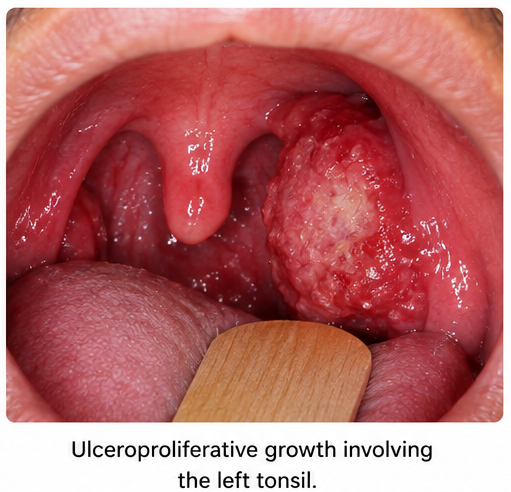
Flexible nasopharyngolaryngoscopy demonstrated a left tonsillar mass without obvious involvement of the larynx or hypopharynx. The vocal cords were mobile bilaterally.
Contrast-enhanced computed tomography of the neck demonstrated an enhancing mass centred on the left palatine tonsillar region with associated ipsilateral cervical lymphadenopathy. There was no radiological evidence of distant metastatic disease on initial staging evaluation.
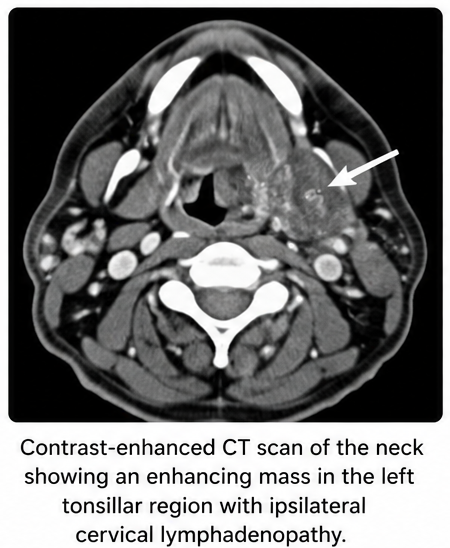
An incisional biopsy of the left tonsillar lesion was performed. Histopathological examination demonstrated invasive nests and sheets of atypical squamous epithelial cells with nuclear pleomorphism, increased mitotic activity, and areas of keratinization, consistent with moderately differentiated squamous cell carcinoma.
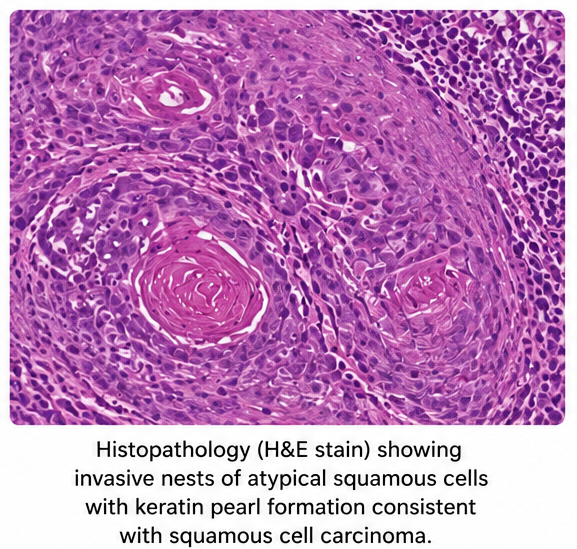
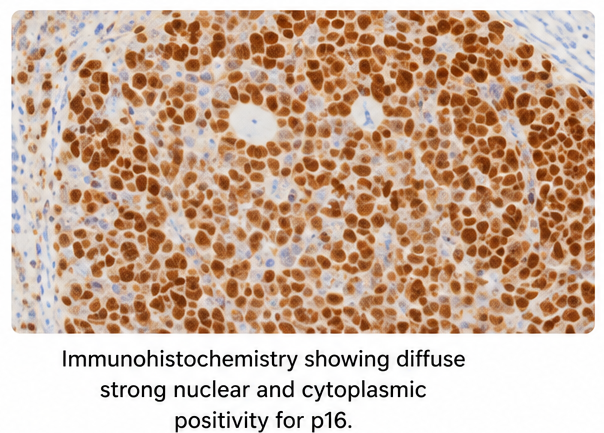
Immunohistochemical staining for p16 was subsequently performed to assess HPV-associated disease. HPV/p16 status was incorporated into the overall staging and treatment assessment, as recommended for oropharyngeal squamous cell carcinoma.
Management and Outcome
The patient was evaluated by a multidisciplinary head and neck oncology team.
Management included:
• Histopathological confirmation of the primary tonsillar lesion
• Assessment of cervical lymph node involvement
• Contrast-enhanced imaging for local and regional staging
• p16 immunohistochemistry for HPV-associated disease assessment
• Evaluation for distant metastatic disease
• Nutritional and dental assessment before definitive treatment
• Definitive treatment planned according to tumour stage, nodal status, HPV/p16 status, and overall functional status
For appropriately selected patients with localized or locally advanced tonsillar squamous cell carcinoma, treatment may involve transoral surgery with or without neck dissection, radiotherapy, or concurrent chemoradiotherapy depending on the clinical and pathological characteristics of the tumour. Modern management emphasizes preservation of oncologic control while minimizing treatment-related morbidity.
In this representative case, the patient underwent definitive multidisciplinary treatment with close surveillance following completion of therapy. The primary lesion demonstrated a favourable clinical response, and subsequent follow-up focused on detection of local recurrence, regional nodal disease, distant metastasis, and treatment-related complications.
Follow-up
One Month
• Significant improvement in throat discomfort and swallowing difficulty
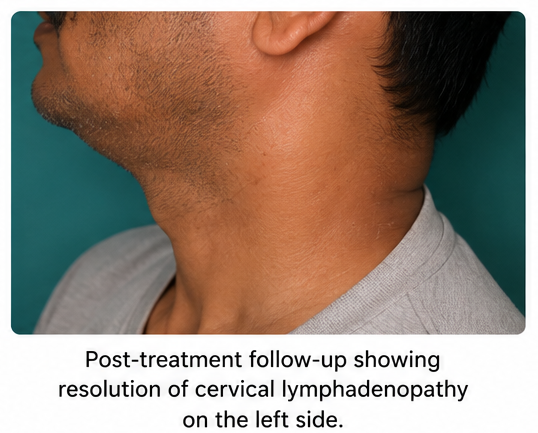
• Reduction in the clinically palpable cervical lymph node
• No evidence of progressive local disease
• Nutritional status improved with supportive care
• No new neurological or airway symptoms
Three Months
• No clinically evident residual tonsillar lesion
• Continued improvement in swallowing function
• Cervical lymphadenopathy substantially regressed
• Follow-up imaging demonstrated a favourable treatment response
• No evidence of distant metastatic disease
Six Months
• Stable oropharyngeal examination
• No clinically apparent local recurrence
• No new cervical lymphadenopathy
• Swallowing function remained stable
• Continued oncological surveillance was advised
Discussion
Tonsillar squamous cell carcinoma is an important form of oropharyngeal cancer with a changing epidemiological profile. Historically, tobacco and alcohol exposure were dominant risk factors. However, HPV-associated disease has become increasingly important, particularly in younger patients with limited tobacco exposure.
The clinical presentation may be subtle. Persistent unilateral throat discomfort, dysphagia, odynophagia, referred otalgia, or an unexplained cervical lymph node should prompt careful examination of the oropharynx. Because the tonsillar region contains abundant lymphatic tissue, cervical nodal metastasis can occur even when the primary tumour is relatively small.
Histopathological examination remains essential for definitive diagnosis. Most oropharyngeal cancers are squamous cell carcinomas, which may be categorized according to their degree of differentiation. HPV-positive tumours arising in the palatine or lingual tonsils represent a distinct molecular and pathological entity and are commonly evaluated using p16 immunohistochemistry as a surrogate marker of HPV-associated disease.
The introduction of HPV-specific staging has significantly changed the assessment of oropharyngeal cancer. The eighth edition of the AJCC staging system introduced a separate staging framework for p16-positive oropharyngeal carcinoma because these tumours have different biological behaviour and generally better outcomes than HPV-unrelated disease.
Treatment selection depends on tumour size, local extension, nodal involvement, HPV/p16 status, patient factors, and institutional expertise. Treatment approaches include surgery, radiotherapy, concurrent chemoradiotherapy, and, in selected advanced or recurrent settings, systemic therapies. Modern treatment strategies increasingly emphasize organ preservation and reduction of long-term functional morbidity without compromising oncological outcomes.
Previous studies of tonsillar squamous cell carcinoma have demonstrated that cervical nodal disease is common and that factors such as lymph vascular invasion can have important prognostic implications.
This case emphasizes the importance of early evaluation of persistent unilateral throat symptoms and cervical lymphadenopathy. Prompt biopsy and appropriate HPV/p16 assessment allow accurate diagnosis, staging, prognostic assessment, and selection of an appropriate treatment strategy.
Prognosis
The prognosis of tonsillar squamous cell carcinoma depends on several factors, including tumor stage, cervical nodal involvement, distant metastasis, HPV/p16 status, smoking history, pathological characteristics, and response to treatment.
HPV-positive oropharyngeal squamous cell carcinomas generally have a more favourable prognosis and better treatment response than HPV-negative tumours. This difference is incorporated into contemporary staging systems.
Patients require long-term surveillance following treatment because recurrence may occur locally, regionally, or at distant sites. Follow-up should also address swallowing function, nutritional status, speech, dental health, and treatment-related toxicities.
Conclusion
Squamous cell carcinoma of the tonsil may present with nonspecific symptoms such as persistent unilateral throat discomfort, dysphagia, referred otalgia, or cervical lymphadenopathy. Early recognition and prompt tissue diagnosis are essential for appropriate management.
Histopathological confirmation, imaging-based staging, and assessment of HPV/p16 status are important components of the diagnostic work-up. The distinction between HPV-associated and HPV-unrelated oropharyngeal squamous cell carcinoma has important implications for staging and prognosis.
This case highlights the importance of maintaining a high index of suspicion for tonsillar malignancy in patients with persistent unilateral throat symptoms or unexplained cervical lymphadenopathy and emphasizes the role of multidisciplinary management in achieving optimal oncological and functional outcomes.
References
1. Ang KK, Harris J, Wheeler R, Weber R, Rosenthal DI, Nguyen-Tân PF, et al. Human papillomavirus and survival of patients with oropharyngeal cancer. N Engl J Med. 2010;363(1):24-35. https://pubmed.ncbi.nlm.nih.gov/20530316/
2. Lydiatt WM, Patel SG, O'Sullivan B, Brandwein MS, Ridge JA, Migliacci JC, et al. Head and neck cancers-major changes in the American Joint Committee on cancer eighth edition cancer staging manual. CA Cancer J Clin. 2017;67(2):122-137. https://pubmed.ncbi.nlm.nih.gov/28128848/
3. Suzuki S, Oridate N, Homma A, Suzuki F, Hatakeyama H, Kano S, et al. Staging and prognosis of oropharyngeal carcinoma according to the 8th Edition of the American Joint Committee on Cancer Staging Manual in human papillomavirus infection. Eur Arch Otorhinolaryngol. 2019;276(3):827-834. https://pubmed.ncbi.nlm.nih.gov/30594962/
4. Mizumachi T, Homma A, Sakashita T, Kano S, Hatakeyama H, Fukuda S. Confirmation of the eighth edition of the AJCC/UICC TNM staging system for HPV-mediated oropharyngeal cancer in Japan. Int J Clin Oncol. 2017;22(4):682-689.https://pubmed.ncbi.nlm.nih.gov/28271391/
5. Wang MB, Liu IY, Gornbein JA, Nguyen CT. HPV-positive oropharyngeal carcinoma: a systematic review of treatment and prognosis. Otolaryngol Head Neck Surg. 2015;153(5):758-769. https://pubmed.ncbi.nlm.nih.gov/26124261/
6. Prigge ES, Arbyn M, von Knebel Doeberitz M, Reuschenbach M. Diagnostic accuracy of p16INK4a immunohistochemistry in oropharyngeal squamous cell carcinomas: a systematic review and meta-analysis. Int J Cancer. 2017;140(5):1186-1198. https://pubmed.ncbi.nlm.nih.gov/27859245
Read more such content on @ Hidoc Dr | Medical Learning App for Doctors
Recommended News For You
Recommended Articles For You
Featured News
Featured Articles
Featured Events
Featured KOL Videos
1.
PNH With Extravascular Hemolysis Approves Factor D Inhibitor.
2.
Breast Cancer Incidence Rises in Asian American Women
3.
FDA Approves Subcutaneous Isatuximab for MM Indications
4.
Healthcare in the Mix in President Biden's Farewell Address
5.
More nonsmokers are getting lung cancer: Oncologist explains why
1.
Aging of Bone-Marrow Immune Niches: Mechanisms, Clinical Impact, and Therapeutic Horizons
2.
AI in Cancer Diagnostics and Imaging Interpretation
3.
The Importance of Early Detection: How Genetics Play a Role in Leucocythemia Diagnosis
4.
Gene Therapy for Hemophilia: A New Hope on the Horizon
5.
The Basics of M.C.V Normal Range for Better Health Management
1.
International Conference on Best Practices in Oncology, Cardiology and Critical Care
2.
International Conference on Innovations in Critical Care for Oncology and Cardiology
3.
International Symposium on Oncology, Cardiology and Critical Care Innovations
4.
International Conference on Cancer Nursing and Hematology Support
5.
International Conference on Clinical Medicine and Surgical Care
1.
Recognizing Symptoms of Vitamin B12 Deficiency
2.
Navigating the Complexities of Ph Negative ALL - Part II
3.
An Eagles View - Evidence-based discussion on Iron Deficiency Anemia- Further Talks
4.
Pazopanib Takes Center Stage in Managing Renal Cell Carcinoma - Part III
5.
Pazopanib Takes Center Stage in Managing Renal Cell Carcinoma - Part IV

Address :
Hidoc Dr. Inc. | Delaware C Corp | 1309 Coffeen Ave. Suite 1200, Sheridan WY, 82801
Phone :
+1-415-463-3094
Email :
anishagadia@hidoc.co
© Copyright 2026 Hidoc Dr. Inc.
Terms & Conditions - LLP | Inc. | Privacy Policy - LLP | Inc. | Account Deactivation

To get started please enter your email ID
Welcome to Hidoc Dr.
Join to enhance your clinical skills and gain specialized in-depth medical knowledge