Mumps Presenting With Bilateral Parotid Swelling, Fever, and Odynophagia: A Case Report
OthersPage Navigation
Abstract
Mumps is an acute viral infection caused by the mumps virus, characterized by inflammation and swelling of the salivary glands, particularly the parotid glands. Although widespread vaccination has substantially reduced disease incidence, mumps continues to occur sporadically and may cause outbreaks, particularly among children, adolescents, and young adults. The clinical presentation may range from mild constitutional symptoms to painful parotitis and complications involving the central nervous system, pancreas, testes, or ovaries. We report the case of a 19-year-old male who presented with fever, bilateral painful swelling over the parotid regions, headache, and difficulty swallowing. Clinical examination demonstrated bilateral parotid enlargement and tenderness without evidence of an abscess. Laboratory investigations revealed mild leukopenia, while serum amylase levels were elevated. Mumps infection was suspected based on the characteristic clinical presentation and subsequently supported by positive mumps-specific immunoglobulin M serology. The patient was managed conservatively with adequate hydration, analgesic therapy, antipyretics, and dietary modification. His symptoms gradually improved, and complete resolution of parotid swelling was observed during follow-up. This case highlights the importance of recognizing the characteristic clinical features of mumps and considering laboratory confirmation when appropriate, particularly in vaccinated populations or patients presenting with atypical features.
Introduction
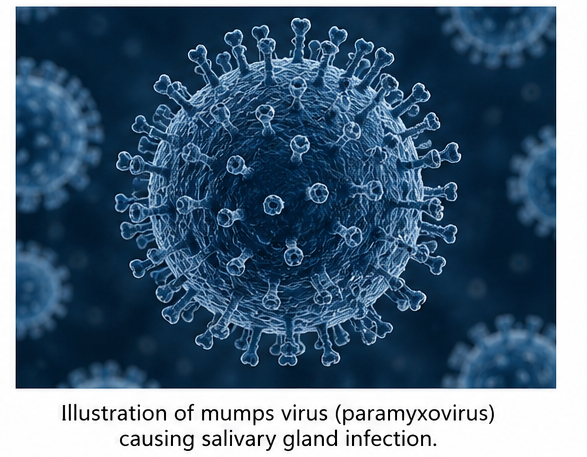
Mumps is a contagious viral disease caused by the mumps virus, an enveloped, single-stranded RNA virus belonging to the Paramyxoviridae family. The infection primarily affects the salivary glands and is classically characterized by painful swelling of one or both parotid glands. Mumps is transmitted mainly through respiratory droplets, saliva, and close personal contact.
The disease most commonly affects children and young adults, although individuals of any age may become infected. Following the introduction of mumps-containing vaccines, the incidence of mumps declined substantially in many countries. However, sporadic cases and outbreaks continue to occur, including among populations with high vaccination coverage.
The incubation period is generally several weeks, after which patients may develop nonspecific prodromal symptoms such as fever, headache, fatigue, myalgia, and anorexia. These symptoms may be followed by the development of painful swelling of the parotid glands. The swelling may be unilateral or bilateral and can cause facial discomfort, ear pain, and difficulty chewing or swallowing.
Although mumps is usually self-limiting, complications may occur. These include aseptic meningitis, encephalitis, orchitis, oophoritis, pancreatitis, and hearing impairment. Orchitis is particularly relevant in postpubertal males and may rarely affect fertility. Neurological complications can also occur, although most patients recover without permanent sequelae.
Clinical diagnosis is often based on the characteristic presentation of acute parotitis accompanied by constitutional symptoms. However, clinical findings alone may not always be sufficient, particularly in vaccinated individuals or during outbreaks when other viral and bacterial causes of parotitis must be considered. Laboratory testing, including detection of mumps-specific immunoglobulin M or viral RNA by reverse transcription polymerase chain reaction, may assist in confirming the diagnosis.
Treatment is primarily supportive because there is no specific antiviral therapy routinely recommended for uncomplicated mumps. Adequate hydration, analgesics, antipyretics, soft foods, and rest are generally sufficient for most patients. Prevention relies primarily on vaccination and appropriate infection-control measures.
We report a case of mumps presenting with bilateral parotid swelling, fever, headache, and odynophagia, emphasizing the importance of clinical recognition, laboratory confirmation, supportive management, and monitoring for complications.
Case Report
A 19-year-old male presented to the outpatient department with a 4-day history of fever, progressively increasing swelling on both sides of the face, and pain over the region of the cheeks and jaw. The patient reported that the swelling had initially developed on the right side and subsequently appeared on the left side approximately 2 days later.
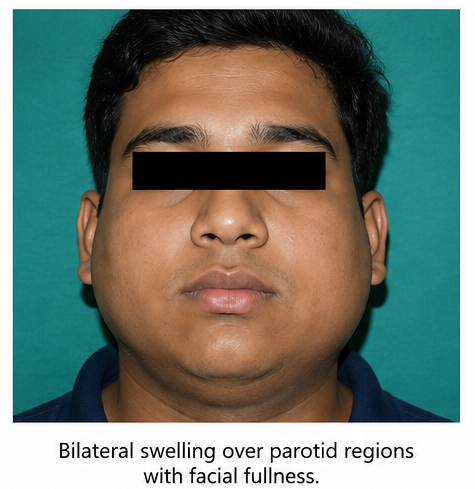
The patient also complained of headache, generalized fatigue, reduced appetite, and difficulty chewing solid food. He experienced increased pain while opening his mouth and swallowing. There was no history of vomiting, abdominal pain, altered sensorium, seizures, or neck stiffness.
The patient denied any recent history of trauma or dental infection. There was no history of chronic systemic illness or immunodeficiency. He did not report recent travel. His vaccination history was uncertain, and documentation of previous mumps-containing vaccination was not available.
On clinical examination, the patient was conscious and oriented but appeared mildly febrile. His temperature was elevated, while blood pressure and respiratory rate were within acceptable limits.
Facial examination demonstrated bilateral diffuse swelling over the preauricular and mandibular regions. The swelling was more prominent on the right side and was associated with tenderness. The overlying skin was not significantly erythematous or warm. The external auditory canals and tympanic membranes appeared normal.
Intraoral examination revealed mild erythema and tenderness around the openings of the parotid ducts. There was no evidence of purulent discharge. The patient had mild difficulty opening his mouth because of pain.
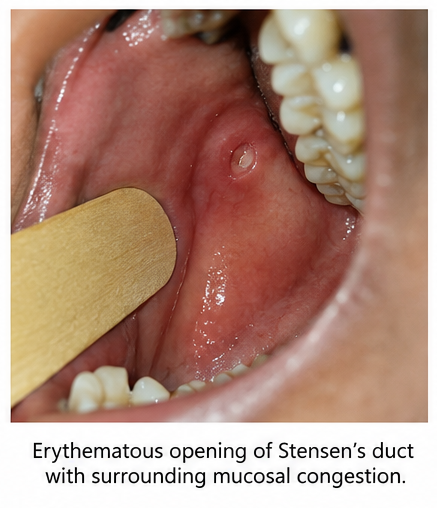
There was no significant cervical lymphadenopathy. Examination of the abdomen was unremarkable, with no tenderness or organomegaly. Neurological examination was normal. In the male genital examination, there was no evidence of testicular swelling or tenderness.
Based on the clinical presentation of fever, bilateral painful parotid swelling, and constitutional symptoms, acute viral parotitis, particularly mumps, was considered the leading diagnosis. Differential diagnoses included bacterial parotitis, other viral infections, obstructive salivary gland disease, and inflammatory disorders of the salivary glands.
Laboratory investigations revealed mild leukopenia. Serum amylase levels were elevated, consistent with salivary gland involvement. Liver and renal function tests were within acceptable limits. There was no significant elevation of inflammatory markers.
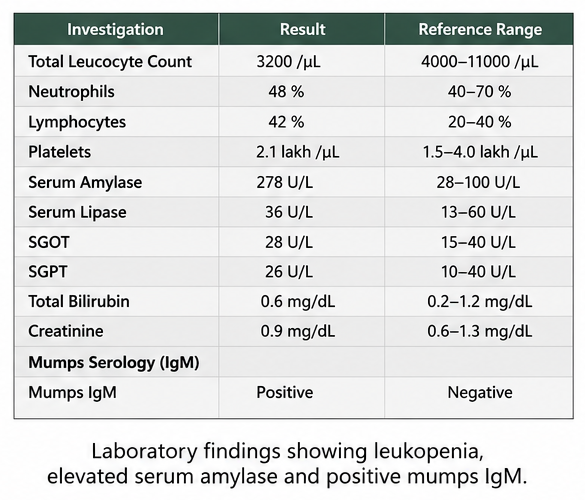
Mumps-specific immunoglobulin M testing was positive, supporting the diagnosis of acute mumps infection. Additional investigations did not demonstrate evidence of bacterial infection.
Based on the clinical findings and laboratory results, a diagnosis of uncomplicated mumps presenting with bilateral parotitis was established.
Management and Outcome
The patient was counseled regarding the viral and self-limiting nature of the infection and the importance of maintaining adequate hydration and rest.
As there is no routinely recommended specific antiviral therapy for uncomplicated mumps, supportive treatment was initiated. The patient was prescribed antipyretic and analgesic therapy for fever and facial pain.
Adequate oral fluid intake was encouraged to prevent dehydration. Because chewing aggravated the parotid pain, the patient was advised to consume soft foods and avoid foods that increased salivary stimulation and discomfort.
The patient was advised to minimize close contact with other individuals during the infectious period to reduce the risk of transmission. Appropriate respiratory and hand hygiene measures were also emphasized.
The patient was monitored for potential complications, including severe headache, neck stiffness, altered consciousness, abdominal pain, and testicular pain or swelling.
Over the following days, the patient's fever gradually subsided, followed by a progressive reduction in facial swelling and parotid tenderness. No neurological, pancreatic, or testicular complications developed.
The patient demonstrated significant clinical improvement with conservative management and was discharged from follow-up after resolution of acute symptoms.
Follow-up
One Week
- The patient's fever had resolved.
- Bilateral parotid swelling had significantly decreased.
- Facial and jaw pain had improved.
- The patient was able to resume a normal diet gradually.
- No neurological or testicular complications were observed.
One Month
- The patient remained clinically stable.
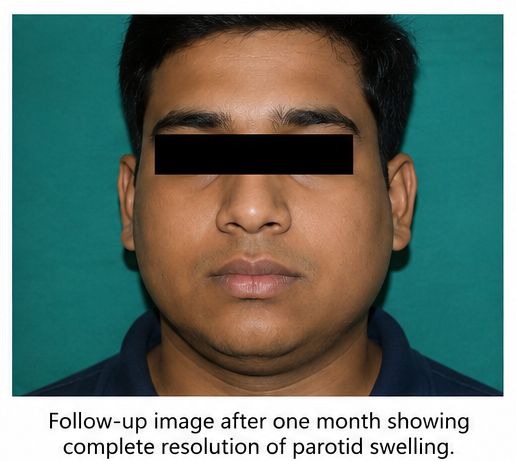
- Complete resolution of parotid swelling was noted.
- No recurrent fever or facial pain was reported.
- No evidence of orchitis, neurological complications, or other systemic manifestations was observed.
Three Months
- The patient remained asymptomatic.
- No recurrence of parotid swelling was noted.
- The patient had returned to normal daily activities.
- Preventive vaccination counseling and routine healthcare follow-up were advised.
Discussion
Mumps is a contagious viral infection that primarily affects the salivary glands, particularly the parotid glands. Although vaccination has significantly reduced the incidence of mumps, outbreaks continue to occur in different populations. Recent epidemiological evidence indicates that mumps remains a global public health concern, with outbreaks reported even among vaccinated populations.
The classical presentation of mumps consists of painful swelling of one or both parotid glands, often accompanied by fever, headache, malaise, myalgia, and anorexia. Parotid swelling may cause facial discomfort and pain during chewing or swallowing. The clinical manifestations may vary considerably between individuals, and some infected patients may have mild or nonspecific symptoms.
In the present case, the patient developed fever followed by progressive bilateral parotid swelling, facial pain, headache, and difficulty chewing. The involvement of both parotid glands and the absence of features suggestive of bacterial infection raised suspicion of viral parotitis.
The differential diagnosis of acute parotid swelling is broad. Bacterial parotitis may present with painful glandular swelling and purulent discharge from the parotid duct, while obstructive disorders may produce recurrent swelling associated with meals. Other viral infections may also cause parotitis. Therefore, clinical evaluation should consider the patient's age, vaccination history, epidemiological exposure, associated symptoms, and the presence or absence of complications.
Laboratory confirmation may be particularly important in vaccinated individuals because the clinical presentation of mumps may be less typical. Mumps-specific immunoglobulin M testing and molecular detection of viral RNA can support the diagnosis. Clinical findings alone may not always be sufficient for definitive diagnosis, particularly when other causes of parotitis are possible.
Mumps is generally a self-limiting infection, and treatment is primarily supportive. Adequate hydration, rest, analgesics, antipyretics, and dietary modification are commonly used to relieve symptoms. Patients should also be counseled regarding infection-control measures because mumps is transmitted through respiratory secretions and close contact.
Although most cases resolve without significant sequelae, complications can occur. Aseptic meningitis is a recognized complication, while orchitis is particularly important in adolescent and adult males. Other possible complications include encephalitis, pancreatitis, oophoritis, and hearing impairment. The risk of complications underscores the importance of appropriate clinical monitoring during the acute illness.
Vaccination remains the principal strategy for preventing mumps. However, outbreaks may occur even in highly vaccinated populations, and waning immunity has been proposed as one factor contributing to disease resurgence. Epidemiological studies have demonstrated that vaccination coverage and vaccine effectiveness influence the likelihood and magnitude of outbreaks.
In the present case, the diagnosis was supported by the characteristic clinical presentation and positive mumps-specific immunoglobulin M testing. The patient responded well to conservative management, and no major complications developed during follow-up.
This case emphasizes that mumps should remain part of the differential diagnosis in patients presenting with acute parotid swelling, even in populations with established vaccination programs. Early recognition, appropriate laboratory confirmation when indicated, supportive treatment, and monitoring for complications are essential components of clinical management.
Prognosis
The prognosis of uncomplicated mumps is generally favorable, with most patients recovering completely with supportive treatment. Parotid swelling and constitutional symptoms typically resolve gradually without permanent complications.
However, clinicians should remain vigilant for complications, particularly in adolescents and adults. Orchitis, aseptic meningitis, encephalitis, pancreatitis, and other systemic manifestations may require additional evaluation and management.
In the present case, the patient showed complete resolution of fever, parotid swelling, and facial pain following conservative treatment. No neurological, pancreatic, or reproductive complications were observed during follow-up.
Conclusion
Mumps should be considered in patients presenting with acute painful parotid swelling, particularly when accompanied by fever and constitutional symptoms. Although the disease is usually self-limiting, its clinical presentation may overlap with other infectious and noninfectious causes of parotitis.
Clinical assessment remains essential, while laboratory confirmation may be useful in vaccinated individuals, atypical cases, or situations where diagnostic uncertainty exists. Supportive treatment, adequate hydration, analgesia, dietary modification, and appropriate infection-control measures form the basis of management for uncomplicated disease.
Clinicians should also monitor patients for potential complications, particularly neurological manifestations and orchitis in postpubertal males. Vaccination remains the most important preventive strategy against mumps and continues to play a central role in reducing disease burden and outbreaks.
This case highlights the importance of maintaining clinical awareness of mumps despite widespread vaccination and demonstrates that timely recognition and appropriate supportive management can result in complete recovery without significant complications.
References
- Agrawal R, Rehman T, Sinha D, et al. Epidemiological trends and determinants of mumps outbreaks: a systematic review and meta-analysis. Front Public Health. 2025;13:1711759. https://pubmed.ncbi.nlm.nih.gov/41426656/
- Melgar M, Yockey B, Marlow MAA. Impact of vaccine effectiveness and coverage on preventing large mumps outbreaks on college campuses: Implications for vaccination strategy. Epidemics. 2022;40:100594. https://pubmed.ncbi.nlm.nih.gov/35728505/
- Anis E, Ram D, Rubin L, et al. Mumps outbreak in Israel's highly vaccinated society: are two doses enough? Epidemiol Infect. 2011;139(8):1223-1230. https://pubmed.ncbi.nlm.nih.gov/21554780/
- Hviid A, Rubin S, Mühlemann K. Mumps. Lancet. 2008;371(9616):932-944. https://pubmed.ncbi.nlm.nih.gov/18342687/
- Dayan GH, Rubin S. Mumps outbreaks in vaccinated populations: are available mumps vaccines effective enough to prevent outbreaks? Clin Infect Dis. 2008;47(11):1458-1467. https://pubmed.ncbi.nlm.nih.gov/18959484/
- Plotkin SA. Mumps: a painful lesson. J Infect Dis. 2012;205(4):481-482. https://pubmed.ncbi.nlm.nih.gov/22186170/
Read more such content on @ Hidoc Dr | Medical Learning App for Doctors
Recommended News For You
Recommended Articles For You
Featured News
Featured Articles
Featured Events
Featured KOL Videos
1.
Promising OS at 5 Years With Chemo-Free Combo in Urothelial Cancer
2.
Black Canadians Face Multiple Barriers to Blood Donation
3.
Stop Calling It Cancer; The Alcohol Paradox; Rural Patients Lose Ground in Screening
4.
Experts say oncology, primary care coordination necessary for best cancer patient outcomes
5.
Neural networks and label-free microscopy enable accurate detection of pancreatic tumors
1.
Machine Learning in Hematology: Boosting Diagnostic Precision and Speed in Medical Practice
2.
Advancing Cancer Care: Insights into Oncology Trials, Immunotherapy, and CAR-T Innovations
3.
Clinical Frameworks in Hematology for Better Care
4.
Empowering Lung Cancer Diagnosis Through the Synergy of Advanced Technologies and Artificial Intelligence
5.
The Benefits of Understanding Haptoglobin High: What You Need to Know
1.
Asian Symposium on Advancement in Hematology and Oncology (ASAHO)
2.
International Cancer Conference
3.
Asian Symposium on Advancement in Hematology and Oncology (ASAHO)
4.
Asian Symposium on Advancement in Hematology and Oncology
5.
Asian Symposium on Advancement in Hematology and Oncology
1.
An Eagles View - Evidence-based Discussion on Iron Deficiency Anemia- Panel Discussion
2.
Untangling The Best Treatment Approaches For ALK Positive Lung Cancer - Part II
3.
Newer Immunotherapies for Myeloma- A Comprehensive Overview- Part II
4.
Managing ALK Rearranged Non-Small Cell Lung Cancer with Lorlatinib - Part IV
5.
An Eagles View - Evidence-based discussion on Iron Deficiency Anemia- Important Points to Know

Address :
Hidoc Dr. Inc. | Delaware C Corp | 1309 Coffeen Ave. Suite 1200, Sheridan WY, 82801
Phone :
+1-415-463-3094
Email :
anishagadia@hidoc.co
© Copyright 2026 Hidoc Dr. Inc.
Terms & Conditions - LLP | Inc. | Privacy Policy - LLP | Inc. | Account Deactivation

To get started please enter your email ID
Welcome to Hidoc Dr.
Join to enhance your clinical skills and gain specialized in-depth medical knowledge