Subconjunctival Hematoma Presenting as Sudden Ocular Redness: A Case Report
OthersPage Navigation
Abstract
Subconjunctival hemorrhage, commonly described as a subconjunctival hematoma, is characterized by bleeding beneath the conjunctiva, producing a sharply demarcated red discoloration over the sclera. Although usually benign and self-limiting, its sudden appearance may cause significant patient anxiety and may occasionally be associated with trauma, hypertension, diabetes mellitus, coagulation abnormalities, or anticoagulant therapy. We report the case of a 48-year-old male who presented with sudden, painless redness of the right eye noticed upon waking. He denied ocular trauma, visual disturbance, pain, photophobia, or discharge. Examination revealed a well-defined subconjunctival blood collection involving the temporal bulbar conjunctiva. Visual acuity and intraocular pressure were normal, with no evidence of corneal or intraocular involvement. Routine hematological and coagulation investigations were unremarkable, while blood pressure was mildly elevated. A diagnosis of spontaneous subconjunctival hemorrhage was established. The patient was managed conservatively with reassurance, observation, and lubricating eye drops. The hemorrhage gradually resolved without visual complications. This case highlights the importance of distinguishing subconjunctival hemorrhage from more serious causes of ocular redness and identifying possible systemic risk factors.
Introduction
Subconjunctival hemorrhage is a common ocular condition caused by rupture of small conjunctival or episcleral blood vessels, resulting in blood accumulation between the conjunctiva and sclera. It typically appears as a sharply demarcated bright-red patch over the white portion of the eye. Despite its dramatic appearance, uncomplicated subconjunctival hemorrhage is generally benign, painless, and does not impair vision.
The condition may occur spontaneously or following minor trauma, eye rubbing, coughing, sneezing, vomiting, straining, or heavy lifting. Systemic hypertension, diabetes mellitus, coagulation disorders, and the use of anticoagulant or antiplatelet medications may also be associated with its occurrence or recurrence.
Diagnosis is primarily clinical. However, pain, photophobia, reduced visual acuity, corneal involvement, or evidence of intraocular inflammation should prompt evaluation for alternative or more serious causes of a red eye. In recurrent or unexplained cases, assessment for systemic risk factors and bleeding disorders may be appropriate.
We report a case of spontaneous subconjunctival hemorrhage presenting as sudden ocular redness, emphasizing appropriate clinical evaluation and conservative management.
Case Report
A 48-year-old male presented to the ophthalmology outpatient department with sudden redness of the right eye, first noticed upon waking. The patient was concerned about the prominent bright-red discoloration over the white portion of the eye.
There was no history of direct ocular trauma, foreign-body exposure, recent ocular surgery, contact lens-related injury, or vigorous eye rubbing. He also denied recent severe coughing, sneezing, vomiting, heavy lifting, or strenuous physical activity.
The patient did not report ocular pain, blurred vision, photophobia, excessive tearing, or ocular discharge. There was no associated headache, epistaxis, gum bleeding, spontaneous bruising, or previous history of recurrent ocular hemorrhage.
He had no known chronic ocular disease and was not receiving anticoagulant or antiplatelet therapy. There was no known history of a bleeding disorder.
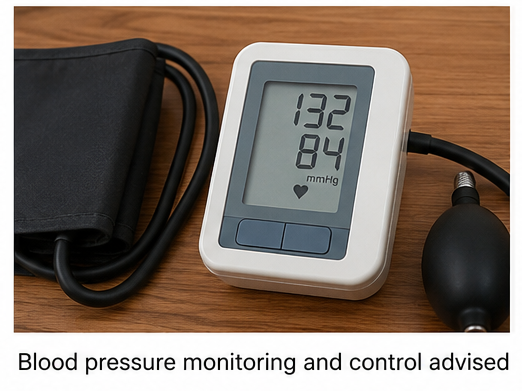
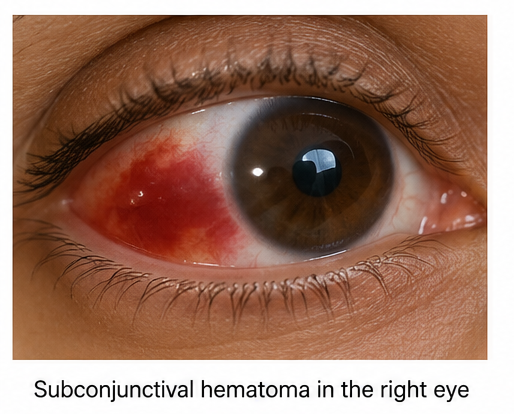
On examination, the patient was conscious, alert, and clinically stable. Blood pressure was mildly elevated at presentation. Ocular examination revealed a sharply demarcated bright-red subconjunctival collection involving the temporal aspect of the right bulbar conjunctiva. There was no evidence of active bleeding.
Visual acuity was preserved bilaterally. Pupillary responses and extraocular movements were normal. Slit-lamp examination confirmed the subconjunctival blood collection, with a clear cornea and no epithelial defect. The anterior chamber was quiet, with no cells or flare. Intraocular pressure was within normal limits, and fundus examination revealed no significant abnormality.
Based on the clinical findings, a diagnosis of spontaneous subconjunctival hemorrhage was established. Differential diagnoses considered included conjunctivitis, episcleritis, scleritis, anterior uveitis, corneal injury, acute glaucoma, and traumatic ocular hemorrhage. The absence of pain, photophobia, visual impairment, corneal involvement, and intraocular inflammation supported the diagnosis of uncomplicated subconjunctival hemorrhage.
Complete blood count and coagulation parameters were within normal limits, with no evidence of significant thrombocytopenia, anemia, or coagulation abnormality. The mildly elevated blood pressure was noted, and the patient was advised to undergo regular blood pressure monitoring.
Management and Outcome
As the patient had uncomplicated subconjunctival hemorrhage with preserved visual acuity and no evidence of trauma or intraocular involvement, conservative management was initiated.
The patient was reassured regarding the benign and self-limiting nature of the condition. Lubricating eye drops were advised for mild ocular irritation. No antibiotics or corticosteroids were prescribed because there was no evidence of infection or ocular inflammation.
The patient was advised to avoid unnecessary eye rubbing and instructed to seek ophthalmological evaluation if he developed ocular pain, photophobia, visual disturbance, worsening redness, or recurrent hemorrhage.
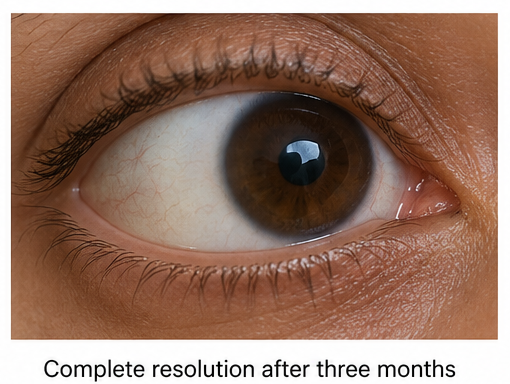
Over the following weeks, the subconjunctival hematoma gradually decreased in size and intensity before resolving completely. No visual impairment, ocular complications, or recurrence was observed.
Follow-up
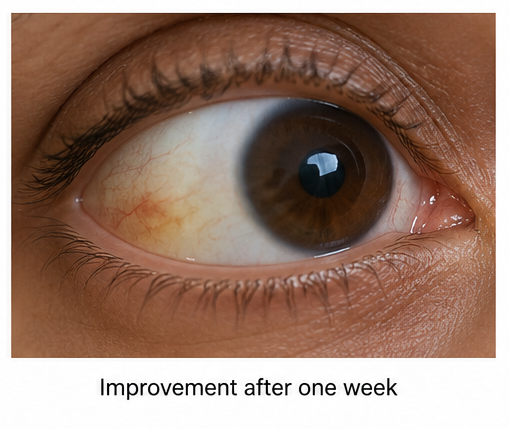
One Week
- Subconjunctival redness had decreased.
- No ocular pain or visual disturbance was reported.
- No new bleeding was observed.
One Month
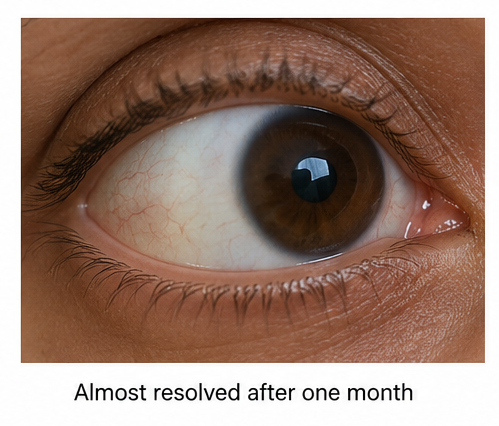
- The hemorrhage had almost completely resolved.
- Visual acuity remained normal.
- No recurrent ocular redness or bleeding was reported.
Three Months
- Complete resolution of the subconjunctival hemorrhage was documented.
- The patient remained asymptomatic.
- No recurrence was observed.
- The patient continued routine blood pressure monitoring.
Discussion
Subconjunctival hemorrhage is a frequent cause of acute ocular redness and results from bleeding beneath the conjunctiva. The condition may occur spontaneously or following minor increases in venous pressure associated with coughing, sneezing, vomiting, straining, or physical exertion. Trauma and eye rubbing are additional potential triggers.
Systemic hypertension, diabetes mellitus, vascular fragility, and abnormalities of platelet or coagulation function may predispose individuals to subconjunctival hemorrhage. Anticoagulant and antiplatelet medications may also increase the risk or extent of bleeding. Recurrent or bilateral episodes should prompt consideration of underlying systemic conditions.
The clinical appearance in the present case was characteristic, with a sharply localized bright-red subconjunctival collection and preserved vision. Importantly, the patient had no ocular pain or photophobia. These findings helped differentiate the condition from potentially serious causes of red eye.
The differential diagnosis of ocular redness includes conjunctivitis, episcleritis, scleritis, anterior uveitis, corneal disease, and acute angle-closure glaucoma. Unlike uncomplicated subconjunctival hemorrhage, these conditions may be associated with pain, photophobia, visual impairment, corneal abnormalities, or intraocular inflammation. Therefore, a focused ocular examination is essential before concluding that a red eye represents a benign subconjunctival hemorrhage.
Laboratory investigations are generally unnecessary for an isolated first episode in an otherwise healthy individual. However, patients with recurrent episodes, extensive hemorrhage, abnormal bleeding history, anticoagulant use, or clinical suspicion of systemic disease may require additional evaluation.
Treatment of uncomplicated subconjunctival hemorrhage is primarily conservative. Patient reassurance is important because the dramatic appearance of the hemorrhage can cause considerable anxiety. Artificial tears may be used for mild irritation, while the hemorrhage itself usually resolves spontaneously through natural resorption.
In the present case, the patient's favorable outcome was associated with the absence of trauma or intraocular pathology and preserved visual function. The hemorrhage resolved completely with conservative management.
Prognosis
The prognosis of uncomplicated subconjunctival hemorrhage is excellent. Most cases resolve spontaneously without permanent visual impairment or ocular sequelae. Larger hemorrhages may require several weeks to completely disappear.
Patients with recurrent or unexplained episodes should be evaluated for systemic hypertension, diabetes, hematological abnormalities, or medication-related bleeding risk. The presence of ocular pain, decreased vision, photophobia, or other atypical findings warrants further ophthalmological assessment.
Conclusion
Subconjunctival hemorrhage is a common and generally benign cause of sudden ocular redness that may appear alarming despite its favorable prognosis. A sharply demarcated blood collection, preserved visual acuity, absence of significant pain, and normal intraocular examination support the diagnosis.
A careful history and ocular examination are essential to exclude trauma and more serious causes of red eye. Assessment of systemic risk factors may be appropriate in recurrent or unexplained cases. Conservative management, reassurance, and observation are generally sufficient for uncomplicated disease.
This case highlights the importance of recognizing subconjunctival hemorrhage as a self-limiting condition while maintaining clinical vigilance for ocular and systemic disorders that may present with similar findings.
References
- Tarlan B, Kiratli H. Subconjunctival hemorrhage: risk factors and potential indicators. Clin Ophthalmol. 2013;7:1163-1170. https://pubmed.ncbi.nlm.nih.gov/23818727/
- Mimura T, Yamagami S, Usui T, et al. Location and extent of subconjunctival hemorrhage. Ophthalmologica. 2010;224(2):90-95. https://pubmed.ncbi.nlm.nih.gov/19844159/
- Fukuyama J, Hayasaka S, Yamada K, Setogawa T. Causes of subconjunctival hemorrhage. Ophthalmologica. 1990;200(2):63-67. https://pubmed.ncbi.nlm.nih.gov/2345661/
- Pitts JF, Jardine AG, Murray SB, Barker NH. Spontaneous subconjunctival haemorrhage—a sign of hypertension? Br J Ophthalmol. 1992;76(10):579-580. https://pubmed.ncbi.nlm.nih.gov/1420063/
- Cugati S, Varma DK, Chen CS, Lee AW. Subconjunctival hemorrhage and its association with hypertension. Clin Exp Optom. 2013;96(4):363-366. https://pubmed.ncbi.nlm.nih.gov/23662948/
Read more such content on @ Hidoc Dr | Medical Learning App for Doctors
Recommended News For You
Recommended Articles For You
Featured News
Featured Articles
Featured Events
Featured KOL Videos
1.
Rural colon cancer patients face higher risks, but minimally invasive surgery could narrow gap
2.
Chemotherapy before surgery helps patients with nose and sinus cancer avoid debilitating eye and bone removal
3.
Laryngeal Transplant Helped a Cancer Patient Speak Again in Pioneering Study
4.
The amount of liver tissue removed during gallbladder surgery has no discernible impact on overall survival.
5.
Long-Acting Interferon Therapy Approved for ET
1.
Molecular Network Mapping in Hematologic Disease
2.
Metabolic Reprogramming of the Tumor Microenvironment: Mechanisms, Clinical Relevance, and Emerging Therapeutic Strategies
3.
Hematopoietic Stem Cell Clonal Dynamics Across the Lifespan
4.
Connected Hematology Laboratory Networks for Automated Cross-Institution Data Exchange
5.
Digital Oncology Ecosystems Integrating Longitudinal Patient Trajectories: Transforming Cancer Care through Data-Driven Innovation
1.
International Conference on Innovations in Critical Care for Oncology and Cardiology
2.
International Conference on Oncology, Cardiology and Critical Care Policy
3.
International Conference on Oncology, Cancer Prevention and Public Health
4.
International Conference on Cancer Nursing and Rehabilitation Strategies
5.
International Conference on Best Practices in Oncology, Cardiology and Critical Care
1.
Breaking Ground: ALK-Positive Lung Cancer Front-Line Management - Part V
2.
Common side effects of cancer treatment and how they are managed
3.
Clinical Excellence in Hematology
4.
Best Practices in Hematology
5.
Current Scenario of Blood Cancer- Further Discussion on Genomic Testing & Advancement in Diagnosis and Treatment

Address :
Hidoc Dr. Inc. | Delaware C Corp | 1309 Coffeen Ave. Suite 1200, Sheridan WY, 82801
Phone :
+1-415-463-3094
Email :
anishagadia@hidoc.co
© Copyright 2026 Hidoc Dr. Inc.
Terms & Conditions - LLP | Inc. | Privacy Policy - LLP | Inc. | Account Deactivation

To get started please enter your email ID
Welcome to Hidoc Dr.
Join to enhance your clinical skills and gain specialized in-depth medical knowledge