Corn Excision from the Foot: Clinical Presentation, Surgical Management, and Outcomes – A Case Report
OthersPage Navigation
Abstract
Foot corns are localized hyperkeratotic lesions that develop in response to chronic pressure and friction, most commonly over weight-bearing areas of the foot. They frequently cause pain, discomfort during ambulation, and impairment in daily activities. Although conservative management with footwear modification, keratolytic agents, and pressure offloading remains the first-line treatment, persistent or recurrent corns may require surgical excision.
We present the case of a 52-year-old female who presented with a painful plantar corn over the forefoot that had progressively worsened over eight months despite multiple conservative treatment attempts. Clinical examination confirmed a well-defined hyperkeratotic lesion associated with localized tenderness and difficulty in walking. Surgical corn excision was performed under local anesthesia, resulting in complete symptom resolution and restoration of normal ambulation.
This case highlights the importance of accurate diagnosis, appropriate patient selection, and surgical intervention in managing refractory plantar corns.
Introduction
A corn (clavus) is a localized area of thickened skin resulting from repetitive pressure or friction over a bony prominence. Corns most commonly occur on the feet, particularly over the metatarsal heads, toes, and other pressure-bearing regions. They represent a protective response of the skin but can become painful when excessive keratin accumulation compresses underlying tissues and nerve endings.
Foot corns are commonly encountered in middle-aged and elderly individuals and may significantly affect mobility and quality of life. Several factors contribute to their development, including poorly fitting footwear, foot deformities, abnormal gait mechanics, and prolonged standing.
Common risk factors include:
• Ill-fitting footwear
• High-heeled shoes
• Foot deformities
• Prominent metatarsal heads
• Hammertoes
• Abnormal gait patterns
• Repetitive mechanical stress
• Prolonged standing occupations
Pathophysiological mechanisms involved in corn formation include:
• Repetitive pressure and friction
• Hyperproliferation of epidermal keratinocytes
• Excessive keratin accumulation
• Formation of a central keratin plug
• Compression of underlying tissues and nerves
Common clinical manifestations include:
• Localized foot pain
• Difficulty walking
• Pain while wearing shoes
• Hyperkeratotic skin lesion
• Tenderness on direct pressure
• Cosmetic concerns
Although most corns respond to conservative treatment, persistent lesions may require surgical intervention to achieve long-term symptom relief.
Case Report
Patient History
A 52-year-old female presented to the outpatient surgical clinic with complaints of:
• Painful lesion on the sole of the right foot for 8 months
• Increasing pain while walking
• Difficulty wearing closed footwear
• Interference with daily activities
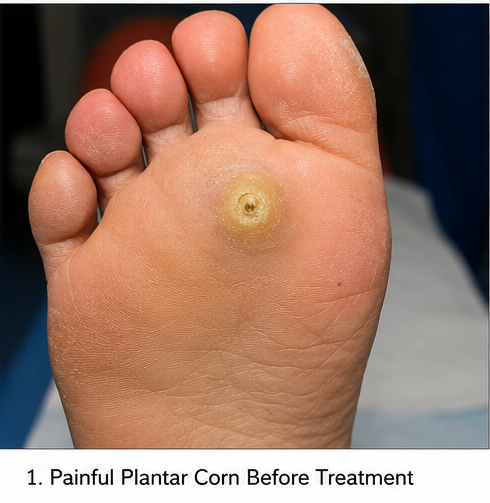
The patient reported gradual progression of symptoms over several months. Pain was initially mild but became severe enough to limit prolonged standing and walking.
Previous treatment history included:
• Salicylic acid preparations
• Foot padding devices
• Footwear modifications
• Periodic paring of the lesion
Despite these measures, symptoms persisted.
Past medical history revealed:
• Mild hypertension controlled with medication
• No diabetes mellitus
• No peripheral vascular disease
There was no history of:
• Foot trauma
• Previous foot surgery
• Neurological disorders
• Rheumatologic disease
Clinical Examination
General Examination
• Blood pressure: 128/82 mmHg
• Pulse rate: 76/min
• Temperature: Afebrile
The patient was clinically stable.
Local Examination
Inspection of the right foot revealed:
• Solitary hyperkeratotic lesion over the plantar aspect of the second metatarsal head
• Well-circumscribed lesion measuring approximately 1 cm in diameter
• Central keratinized core
• Surrounding thickened skin
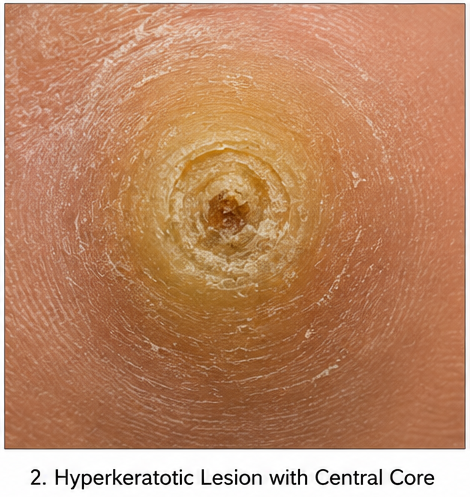
Palpation demonstrated:
• Significant tenderness on direct pressure
• Firm central keratin plug
• No local warmth
• No discharge or ulceration
The lesion caused discomfort during weight bearing.
Neurovascular Examination
Assessment revealed:
• Intact peripheral pulses
• Normal capillary refill
• Preserved sensation
• No evidence of neuropathy
The remainder of the foot examination was unremarkable.
Clinical Evaluation
Differential Diagnosis
The following conditions were considered:
• Plantar corn (clavus)
• Plantar wart (verruca plantaris)
• Callus
• Epidermal inclusion cyst
• Foreign body granuloma
The presence of a localized hyperkeratotic lesion with a central keratin core and tenderness on direct pressure strongly favored the diagnosis of a plantar corn.
Investigations
Laboratory Evaluation
Routine investigations demonstrated:
• Normal complete blood count
• Normal renal function tests
• Normal blood glucose levels
Foot Radiography
Plain radiographs were obtained to evaluate underlying bony abnormalities.
Findings included:
• Mild prominence of the second metatarsal head
• No fracture
• No osteomyelitis
• No foreign body
Dermoscopic Evaluation
Dermoscopy demonstrated:
• Dense central keratin core
• Preservation of normal skin lines
• Absence of thrombosed capillaries
These findings helped differentiate the lesion from a plantar wart.
Diagnosis
Based on clinical examination and investigative findings, a diagnosis of:
Painful Refractory Plantar Corn (Clavus) Over the Second Metatarsal Head
was established.
Management and Outcome
Initial Management
The patient was counseled regarding available treatment options.
Conservative measures had already failed, including:
• Keratolytic therapy
• Mechanical offloading
• Protective padding
• Footwear modifications
Given persistent symptoms, surgical excision was recommended.
Surgical Procedure
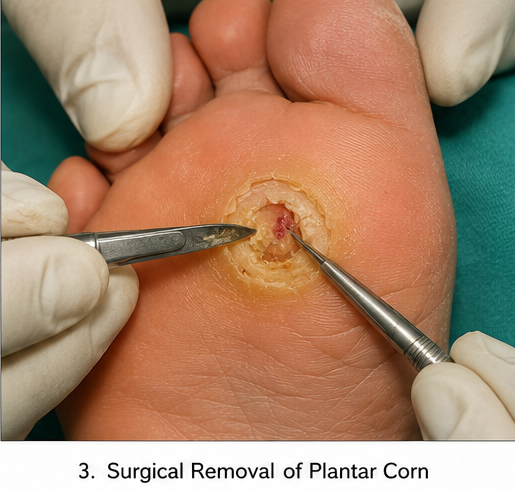
Corn excision was performed under local anesthesia.
The procedure involved:
• Sterile preparation of the operative field
• Local infiltration with lidocaine
• Excision of the hyperkeratotic lesion
• Removal of the central keratin core
• Careful curettage of residual keratinized tissue
• Hemostasis and wound dressing
The procedure was completed without complications.
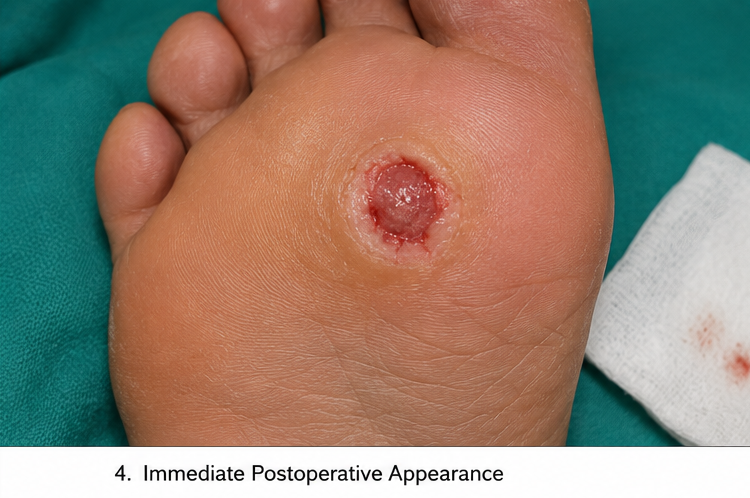
Postoperative Care
Postoperative management included:
• Analgesics as required
• Daily wound care
• Pressure avoidance instructions
• Protective footwear advice
The patient was advised to minimize excessive weight bearing during the initial healing phase.
Follow-Up and Clinical Course
At 1 Week
• Mild postoperative discomfort
• Healthy wound healing
• No evidence of infection
• Improved weight-bearing tolerance
At 2 Weeks
• Complete epithelialization of the wound
• Marked reduction in pain
• Improved walking ability
At 1 Month
• Complete symptom resolution
• Normal ambulation
• No tenderness at the operative site
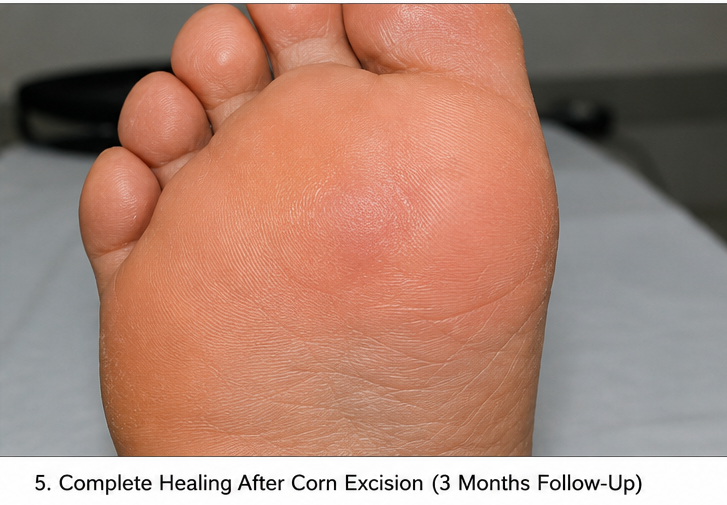
At 3 Months
• Excellent cosmetic outcome
• No recurrence of the lesion
• Full return to daily activities
At 6 Months
• Persistent symptom-free status
• No evidence of recurrence
• High patient satisfaction
Discussion
Pathophysiology
Corns develop as a protective response to chronic mechanical stress. Repeated pressure stimulates excessive keratin production, leading to localized thickening of the epidermis.
The central keratin plug characteristic of corns exerts pressure on underlying tissues, producing pain during walking and standing.
Key pathological processes include:
• Chronic pressure
• Friction-induced epidermal hyperplasia
• Keratin accumulation
• Central core formation
• Compression of sensory nerve endings
Persistent mechanical stress promotes recurrence if the underlying cause is not addressed.
Epidemiology
Important epidemiological features include:
• Common in adults and elderly individuals
• More frequent in women
• Associated with inappropriate footwear
• Frequently observed in patients with foot deformities
• Common among individuals with prolonged standing occupations
The prevalence increases with age due to progressive biomechanical changes of the foot.
Clinical Manifestations
Patients typically present with:
• Localized pain
• Walking difficulty
• Tenderness during weight bearing
• Thickened skin lesion
• Footwear intolerance
Characteristic signs include:
• Hyperkeratotic lesion
• Central translucent core
• Localized tenderness
• Absence of inflammatory changes
Pain is usually more pronounced with direct pressure.
Diagnostic Considerations
Diagnosis is primarily clinical and based on:
- Detailed patient history
- Physical examination
- Dermoscopic evaluation
- Radiographic assessment when indicated
The most important differential diagnosis is plantar wart, which often demonstrates interrupted skin lines and thrombosed capillaries.
Treatment Modalities
Conservative Treatment
Initial treatment generally includes:
• Footwear modification
• Pressure redistribution
• Orthotic devices
• Salicylic acid therapy
• Periodic debridement
These approaches are effective in many patients.
Surgical Excision
Surgical treatment is considered when:
• Conservative measures fail
• Pain significantly affects function
• Recurrence is frequent
• Underlying pressure points require correction
Benefits include:
• Immediate removal of the lesion
• Rapid symptom relief
• Improved quality of life
• Low recurrence when pressure factors are addressed
Complications
Potential complications include:
• Wound infection
• Delayed healing
• Scar formation
• Recurrence
• Persistent pain
Appropriate postoperative care significantly reduces these risks.
Prognosis
The prognosis is generally excellent following complete excision and correction of mechanical pressure factors.
Factors influencing outcomes include:
• Adequacy of excision
• Footwear modification
• Underlying foot anatomy
• Patient compliance
Most patients experience substantial improvement in pain and mobility.
Conclusion
Plantar corns are common hyperkeratotic lesions that may cause significant pain and functional limitation. Although conservative treatment remains the cornerstone of management, persistent symptomatic lesions may require surgical excision for definitive relief. This case demonstrates the successful management of a refractory plantar corn through surgical excision, resulting in complete symptom resolution, restoration of normal ambulation, and excellent long-term outcomes. Early recognition, appropriate patient selection, and correction of underlying mechanical factors remain essential for preventing recurrence and optimizing patient satisfaction.
References
- Helal B, Faris L. Surgery for resistant corns. A prospective study. Journal of Bone and Joint Surgery British Volume. 1984;66(5):719-721. https://pubmed.ncbi.nlm.nih.gov/6501367/
- Landorf KB, Menz HB. Plantar calluses and corns. BMJ Clinical Evidence. 2008;2008:1112. https://pubmed.ncbi.nlm.nih.gov/19450337/
- Grouios G. Corns and calluses: Overview and treatment considerations. Clinics in Podiatric Medicine and Surgery. 2016;33(3):341-352. https://pubmed.ncbi.nlm.nih.gov/27215154/
- D'Août K, Pataky TC, De Clercq D, Aerts P. The effects of habitual footwear use on foot structure and function. Footwear Science. 2009;1(2):81-94. https://pubmed.ncbi.nlm.nih.gov/19885176/
- Singh D, Bentley G, Trevino SG. Callosities, corns, and calluses. BMJ. 1996;312(7043):1403-1406. https://pubmed.ncbi.nlm.nih.gov/8664662/
- American College of Foot and Ankle Surgeons. Corns and Calluses. https://www.foothealthfacts.org/conditions/corns-and-calluses
- American Academy of Dermatology Association. Corns and Calluses: Diagnosis and Treatment. https://www.aad.org/public/diseases/a-z/corns-and-calluses-treatment
- National Health Service (NHS). Corns and Calluses. https://www.nhs.uk/conditions/corns-and-calluses/
- Burns J, Crosbie J, Hunt A, Ouvrier R. The effect of pes cavus on foot pain and plantar pressure distribution. Foot. 2005;15(4):205-212. https://pubmed.ncbi.nlm.nih.gov/16517475/
Read more such content on @ Hidoc Dr | Medical Learning App for Doctors
Recommended News For You
Recommended Articles For You
Featured News
Featured Articles
Featured Events
Featured KOL Videos
1.
Triplet Therapy Improves Posttransplant Outcomes in Myeloma
2.
Primary Sjögren's syndrome patients' B-Cell Stimulating Factors are associated with the growth of lymphomas.
3.
Cancer detection recovered following pandemic disruptions
4.
Telehealth in the pandemic era resulted in fewer therapy interruptions.
5.
Asian Women With Breast Cancer Outlive White Peers
1.
Decoding Efficacy, Safety, and Future Frontiers in CAR-T Cell Therapy for Hematologic Malignancies Towards CAR-T Therapy 2025
2.
Exploring the Normal Range of Monocytes: A Comprehensive Guide
3.
Tailoring the Immune Response: The Dawn of Personalized Vaccines in Cancer Immunotherapy
4.
Advancements in Breast Cancer Treatment: From Chemotherapy to Immunotherapy
5.
Emerging Insights in Hematology for Better Care
1.
International Conference on Oncology, Cancer Prevention and Public Health
2.
International Conference on Cancer Nursing and Rehabilitation Strategies
3.
International Conference on Best Practices in Oncology, Cardiology and Critical Care
4.
International Conference on Innovations in Critical Care for Oncology and Cardiology
5.
International Symposium on Oncology, Cardiology and Critical Care Innovations

Address :
Hidoc Dr. Inc. | Delaware C Corp | 1309 Coffeen Ave. Suite 1200, Sheridan WY, 82801
Phone :
+1-415-463-3094
Email :
anishagadia@hidoc.co
© Copyright 2026 Hidoc Dr. Inc.
Terms & Conditions - LLP | Inc. | Privacy Policy - LLP | Inc. | Account Deactivation

To get started please enter your email ID
Welcome to Hidoc Dr.
Join to enhance your clinical skills and gain specialized in-depth medical knowledge