Mania With Psychotic Features Presenting with Decreased Need for Sleep, Excessive Energy, and Grandiose Delusions: A Case Report
OthersPage Navigation
Abstract
Mania is a severe mood disturbance characterized by persistently elevated, expansive, or irritable mood accompanied by increased energy or goal-directed activity and significant behavioural and functional changes. Severe manic episodes may be associated with psychotic symptoms, impaired judgment, impulsive behaviour, and substantial social or occupational consequences. Early recognition and appropriate treatment are essential to prevent harm and facilitate recovery. We report the case of a young adult who presented with a 10-day history of markedly decreased need for sleep, excessive energy, increased talkativeness, multiple goal-directed business activities, impulsive spending, and an elevated mood. Mental status examination revealed a euphoric mood, pressured speech, and grandiose delusions characterized by the belief that the patient possessed special powers. The clinical presentation was consistent with a manic episode with psychotic features. The case highlights the importance of recognizing characteristic manic symptoms, distinguishing mania from hypomania and other psychiatric conditions, assessing associated risks, and initiating timely pharmacological and psychosocial management.
Introduction
Mania is a defining clinical feature of bipolar I disorder and represents a significant psychiatric emergency when symptoms are severe or accompanied by psychotic features. It is characterized by a distinct period of abnormally elevated, expansive, or irritable mood with increased energy or activity, accompanied by symptoms such as decreased need for sleep, grandiosity, pressured speech, racing thoughts, distractibility, increased goal-directed activity, and excessive involvement in activities with potentially harmful consequences.
Unlike hypomania, mania causes marked functional impairment, may require hospitalization, or may be accompanied by psychotic features. The presence of delusions or hallucinations during an elevated mood episode therefore indicates a manic episode rather than hypomania.
Psychotic symptoms during mania may include grandiose, persecutory, or other delusional beliefs. Grandiosity may become extreme, with patients developing unrealistic beliefs about their abilities, wealth, influence, or special powers. Impulsivity and impaired judgment can result in excessive spending, risky investments, interpersonal difficulties, and other potentially harmful behaviours.
Comprehensive assessment should include evaluation of symptom severity, functional impairment, psychotic symptoms, substance use, medical causes of secondary mania, and risk of harm to self or others. Current Indian guidelines emphasize careful assessment of the episode, associated psychotic features, risk factors, and previous psychiatric history before treatment selection.
We report a case of a young adult presenting with prominent manic symptoms and grandiose delusions, illustrating the clinical features that distinguish mania with psychotic features from other mood and psychiatric disorders.
Case Report
A young adult presented with behavioural and mood changes characterized by a markedly reduced need for sleep, increased energy, excessive talking, and increased goal-directed activity for approximately 10 days.
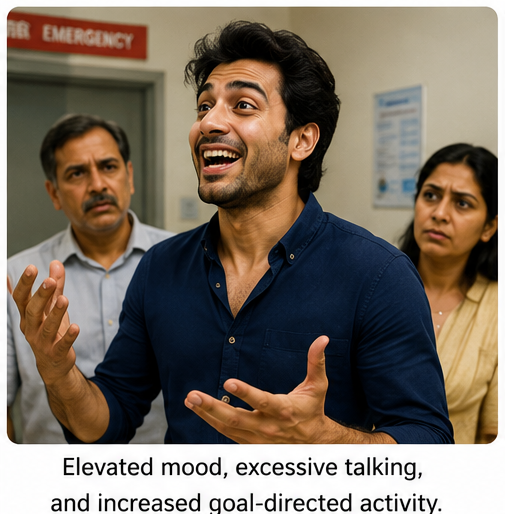
According to the clinical history, the patient had been sleeping for only approximately two hours per night during this period but continued to report high levels of energy. The patient had become increasingly active and had initiated multiple business projects simultaneously.

There was also evidence of impaired judgment and impulsive behaviour, including spending a large amount of money without appropriate consideration of the consequences. The patient demonstrated an elevated and euphoric mood and displayed markedly increased verbal output.
During mental status examination, the patient appeared euphoric and highly energetic. Speech was rapid and pressured, with difficulty interrupting the patient during conversation. Thought content was notable for grandiose beliefs, including the conviction that the patient possessed "special powers."
The combination of decreased need for sleep, increased energy, excessive talkativeness, increased goal-directed activity, impulsive spending, euphoric mood, pressured speech, and grandiose delusions was highly suggestive of a manic episode with psychotic features.

The presence of psychotic symptoms and significant behavioural disturbance favored mania over hypomania. A comprehensive psychiatric assessment was indicated to evaluate functional impairment, safety risks, substance exposure, medical causes of secondary mania, and the possibility of an underlying bipolar disorder.
Management and Outcome
Management of acute mania requires assessment of the severity of symptoms, behavioural disturbance, psychotic features, insight, judgment, and potential risk to the patient or others. Hospital-based management may be required when symptoms are severe, behavioural control is impaired, or safety cannot be adequately maintained in an outpatient setting.
Treatment generally consists of pharmacological therapy directed toward rapid control of manic and psychotic symptoms, followed by maintenance treatment to reduce the risk of recurrence. Evidence-based options for acute mania include antipsychotic medications and mood stabilizers. The 2018 CANMAT/ISBD guidelines list lithium, quetiapine, divalproex, asenapine, aripiprazole, paliperidone, risperidone, and cariprazine among first-line options for acute mania.
The 2025 update of the Indian Psychiatric Society guidelines similarly recommends a phase-specific approach to bipolar disorder management, with treatment selection based on efficacy, tolerability, availability, affordability, and individual patient characteristics.
In patients with prominent psychotic symptoms or severe behavioural disturbance, an antipsychotic may be particularly important, with a mood stabilizer considered according to clinical severity and individual circumstances. Supportive measures include reduction of environmental stimulation, restoration of sleep, monitoring of behaviour and physical health, psychoeducation, and involvement of family or caregivers when appropriate.
Follow-up
Initial Phase
- Markedly decreased need for sleep, with approximately two hours of sleep per night
- Persistent elevated/euphoric mood
- Increased energy and goal-directed activity
- Excessive and pressured speech
- Impulsive financial behaviour
- Grandiose delusions involving special powers
Clinical Assessment
- Mental status examination consistent with a manic state
- Prominent psychotic symptoms in the form of grandiose delusions
- Significant impairment in judgment and behavioural control
- Assessment required to exclude substance-induced and secondary medical causes of mania
Subsequent Follow-up
Continued psychiatric follow-up is essential to monitor improvement in sleep, mood elevation, speech pressure, impulsivity, psychotic symptoms, treatment adherence, and functional recovery. Maintenance treatment following a manic episode should be individualized, particularly when the episode is severe, associated with psychosis, or requires hospitalization.
Discussion
Mania is characterized by a distinct period of elevated, expansive, or irritable mood accompanied by increased energy or activity. Diagnostic criteria require several associated symptoms, including grandiosity, decreased need for sleep, increased talkativeness or pressured speech, racing thoughts, distractibility, increased goal-directed activity, or excessive involvement in activities with potentially harmful consequences.

The present case demonstrates several classical manifestations of mania. The patient's ability to function on approximately two hours of sleep per night without apparent fatigue represents a decreased need for sleep, rather than simple insomnia. This distinction is clinically important because decreased need for sleep is a characteristic symptom of mania.
The marked increase in energy and simultaneous initiation of multiple business projects represents increased goal-directed activity. However, this activity was accompanied by impaired judgment and excessive financial expenditure, illustrating how manic symptoms can lead to significant psychosocial and economic consequences.
Pressured speech and excessive talking are also characteristic manifestations of mania. The patient may speak rapidly, continuously, and with difficulty being interrupted. This can occur alongside accelerated thought processes and impaired concentration.
The most clinically significant feature in this case was the presence of grandiose delusions, specifically the belief in possessing special powers. Psychotic symptoms can occur during severe manic episodes and may be mood-congruent, particularly when they involve exaggerated abilities, status, wealth, or power. Their presence indicates a more severe clinical state and distinguishes mania from hypomania.

Several differential diagnoses should be considered when evaluating a patient with elevated mood and behavioural changes. These include hypomania, substance- or medication-induced mood disorder, schizophrenia-spectrum disorders, schizoaffective disorder, attention-deficit/hyperactivity disorder, personality disorders, and medical conditions capable of producing secondary mania. The temporal relationship between symptoms and substance or medication exposure, together with physical examination and appropriate investigations, is important in establishing the diagnosis.
Treatment of acute mania focuses on rapid stabilization of mood and behaviour. Antipsychotic medications and mood stabilizers are established treatment options, with combination therapy frequently considered in severe episodes. Current evidence-based guidelines emphasize individualized treatment selection based on symptom severity, psychosis, previous response, comorbidities, tolerability, and patient preference.
The case highlights the importance of recognizing the characteristic combination of decreased need for sleep, elevated mood, increased energy, pressured speech, excessive goal-directed activity, impulsive behaviour, and grandiosity. Early identification can facilitate appropriate intervention and reduce the risk of financial, social, occupational, and safety-related consequences.
Prognosis
The prognosis of a manic episode depends on its severity, presence of psychotic symptoms, degree of functional impairment, treatment response, adherence, comorbid substance use, and the underlying course of bipolar disorder.
Patients with acute mania can achieve substantial symptomatic improvement with appropriate pharmacological and psychosocial management. However, recurrence is possible, making continued psychiatric monitoring and maintenance treatment important.
Episodes associated with psychotic symptoms or significant functional disruption may represent a more severe form of illness and warrant careful long-term follow-up. Current Indian guidelines recommend individualized consideration of maintenance treatment after a first manic episode, particularly when psychotic symptoms, severe impairment, hospitalization, or substantial consequences are present.
Conclusion
Mania is a clinically significant mood disorder characterized by elevated or expansive mood, increased energy, reduced need for sleep, pressured speech, increased goal-directed activity, impaired judgment, and potentially psychotic symptoms.
This case demonstrates a classic presentation of mania with psychotic features, with decreased need for sleep, excessive energy, multiple goal-directed activities, impulsive spending, euphoric mood, pressured speech, and grandiose delusions. Recognition of these characteristic features is essential for distinguishing mania from hypomania and other psychiatric conditions.
Early psychiatric assessment, appropriate risk evaluation, timely pharmacological treatment, restoration of sleep, psychosocial support, and structured long-term follow-up are essential components of effective management. Current treatment guidelines support individualized use of antipsychotics and mood stabilizers for acute mania and emphasize maintenance strategies to reduce relapse and improve long-term outcomes.
References
- Yatham LN, Kennedy SH, Parikh SV, et al. Canadian Network for Mood and Anxiety Treatments (CANMAT) and International Society for Bipolar Disorders (ISBD) 2018 guidelines for the management of patients with bipolar disorder. Bipolar Disord. 2018;20(2):97-170. https://pubmed.ncbi.nlm.nih.gov/29536616/
- Menon V, Ganesh R, Deep R, et al. Clinical practice guidelines for the management of bipolar disorder: 2025 update. Indian J Psychiatry. 2026;68(1):8-43. https://pubmed.ncbi.nlm.nih.gov/41694044/
- Shah N, Grover S, Rao GP, et al. Clinical Practice Guidelines for Management of Bipolar Disorder. Indian J Psychiatry. 2017;59(Suppl 1):S51-S66.https://pmc.ncbi.nlm.nih.gov/articles/PMC5310104/
- Keramatian K, Chithra NK, Yatham LN. The CANMAT and ISBD Guidelines for the Treatment of Bipolar Disorder: Summary and a 2023 Update of Evidence. FOCUS. 2023;21(4):344-353. https://pubmed.ncbi.nlm.nih.gov/38695002/
- Oral TE. Treatment of acute mania. Neuro Endocrinol Lett. 2005;26(Suppl 1):9-2 https://pubmed.ncbi.nlm.nih.gov/16361986/
- McIntyre RS, et al. Treatment of mania, mixed state, and rapid cycling. CNS Spectr. 1997. https://pubmed.ncbi.nlm.nih.gov/9288440/
- Keck PE Jr, McElroy SL. Mania, psychosis, and antipsychotics. J Clin Psychiatry. 1995. https://pubmed.ncbi.nlm.nih.gov/8626366/
Read more such content on @ Hidoc Dr | Medical Learning App for Doctors
Recommended News For You
Recommended Articles For You
Featured News
Featured Articles
Featured Events
Featured KOL Videos
1.
Study suggests exercise could reduce breast cancer recurrence
2.
Dense breasts: What it means and what women can do about screening
3.
Exercise may help breast cancer survivors manage weight
4.
For patients with prostate cancer, long-term follow-up helps identify treatment side effects.
5.
New CAR T-Cell Therapy Approved for Leukemia
1.
Evolutionary Bottlenecks in Tumor Progression
2.
PARP Inhibitors in Testicular Cancer: Tackling Cisplatin Resistance with Precision
3.
Understanding Vaso Occlusive Crisis: Symptoms, Causes, and Management Strategies
4.
Studying Lactic Acid in Pediatric Tumor Microenvironments: Experimental Approaches Explored
5.
Uncovering the Mysteries of Breast Cancer: The Journey to a Cure
1.
Asian Symposium on Advancement in Hematology and Oncology (ASAHO)
2.
International Cancer Conference
3.
Asian Symposium on Advancement in Hematology and Oncology (ASAHO)
4.
Asian Symposium on Advancement in Hematology and Oncology
5.
Asian Symposium on Advancement in Hematology and Oncology
1.
Preventing Blood Clots: The Importance of Venous Thromboembolism Management
2.
Navigating the Complexities of Ph Negative ALL - Part III
3.
An Eagles View - Evidence-based Discussion on Iron Deficiency Anemia- Panel Discussion IV
4.
A Comprehensive Guide to First Line Management of ALK Positive Lung Cancer - Part VIII
5.
Breaking Ground: ALK-Positive Lung Cancer Front-Line Management - Part II

Address :
Hidoc Dr. Inc. | Delaware C Corp | 1309 Coffeen Ave. Suite 1200, Sheridan WY, 82801
Phone :
+1-415-463-3094
Email :
anishagadia@hidoc.co
© Copyright 2026 Hidoc Dr. Inc.
Terms & Conditions - LLP | Inc. | Privacy Policy - LLP | Inc. | Account Deactivation

To get started please enter your email ID
Welcome to Hidoc Dr.
Join to enhance your clinical skills and gain specialized in-depth medical knowledge