Pernicious Anemia Presenting With Severe Vitamin B12 Deficiency and Neurological Manifestations: A Case Report
OthersPage Navigation
Abstract
Pernicious anemia is an autoimmune disorder characterized by impaired vitamin B12 absorption due to intrinsic factor deficiency and autoimmune destruction of gastric parietal cells. Untreated vitamin B12 deficiency can cause megaloblastic anemia and neurological dysfunction, which may become irreversible if treatment is delayed. We report the case of a 48-year-old woman who presented with progressive fatigue, generalized weakness, exertional dyspnea, numbness, tingling of both feet, and difficulty maintaining balance. Laboratory investigations revealed severe macrocytic anemia and markedly reduced serum vitamin B12 levels. Further evaluation demonstrated elevated methylmalonic acid and homocysteine levels, along with positive intrinsic factor and anti-parietal cell antibodies, confirming pernicious anemia. The patient was treated with parenteral vitamin B12 replacement, resulting in significant hematological improvement and gradual resolution of neurological symptoms. This case highlights the importance of early recognition of pernicious anemia and prompt vitamin B12 replacement to prevent potentially irreversible neurological complications.
Introduction
Pernicious anemia is a chronic autoimmune condition that causes vitamin B12 deficiency due to impaired absorption of cobalamin. Autoimmune destruction of gastric parietal cells and antibodies against intrinsic factor interfere with the normal absorption of dietary vitamin B12 in the terminal ileum.
Vitamin B12 is essential for DNA synthesis, normal erythrocyte maturation, and neurological function. Deficiency can therefore cause fatigue, pallor, weakness, exertional dyspnea, glossitis, paresthesia, peripheral neuropathy, gait abnormalities, and cognitive changes.
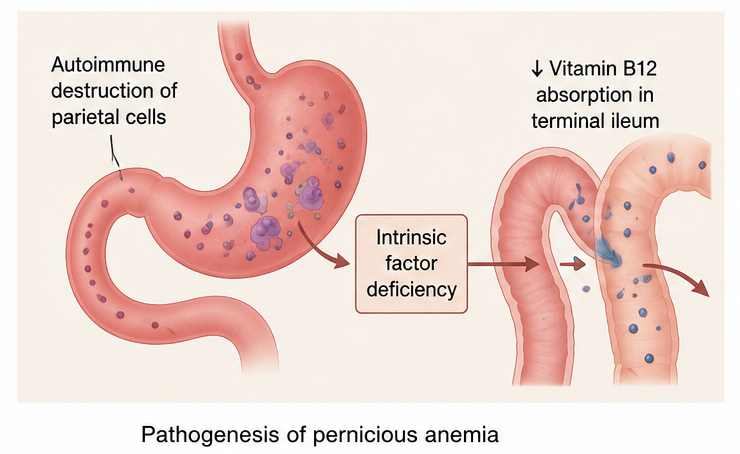
Pernicious anemia may develop gradually, allowing patients to remain relatively asymptomatic despite severe biochemical deficiency. Neurological manifestations may occur with or without prominent anemia and can become irreversible if treatment is delayed. Diagnosis involves clinical assessment and laboratory evaluation, including complete blood count, peripheral blood smear, serum vitamin B12, and, when indicated, methylmalonic acid, homocysteine, and autoimmune antibody testing.
We report a case of pernicious anemia presenting with severe vitamin B12 deficiency, macrocytic anemia, and neurological manifestations that improved following timely parenteral vitamin B12 replacement.
Case Report
A 48-year-old woman presented with a 6-month history of progressive fatigue, generalized weakness, reduced exercise tolerance, and exertional shortness of breath. During the preceding 3 months, she had developed numbness and tingling involving both feet, gradually extending to the lower legs. She also reported difficulty maintaining balance while walking, particularly in dimly lit environments.
There was no history of fever, significant weight loss, chronic diarrhea, gastrointestinal bleeding, or recent infection. She reported reduced appetite but no significant dietary restriction. There was no history of alcohol abuse or use of medications known to interfere substantially with vitamin B12 absorption. She had no known diabetes mellitus, chronic kidney disease, or neurological disorder.
On examination, the patient appeared pale and mildly fatigued. Her pulse rate was mildly elevated, while blood pressure and respiratory rate were within normal limits. Oral examination revealed a smooth, mildly erythematous tongue suggestive of glossitis.
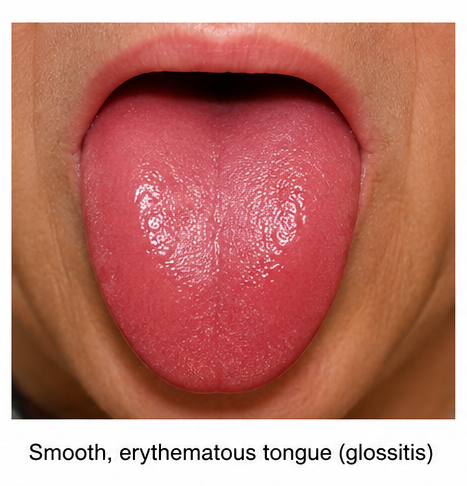
Neurological examination demonstrated reduced vibration and proprioception in both lower limbs, with mild gait and balance impairment. Muscle strength was preserved, with no focal motor deficit.
Laboratory investigations revealed severe macrocytic anemia with increased mean corpuscular volume. Peripheral blood smear demonstrated macro-ovalocytes and hypersegmented neutrophils, consistent with megaloblastic anemia.

Serum vitamin B12 was markedly reduced, while serum folate was within the normal range.
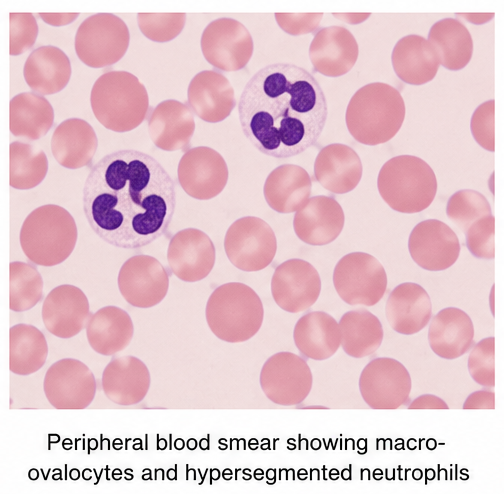
Further testing showed significantly elevated methylmalonic acid and homocysteine levels, supporting functional vitamin B12 deficiency. Iron studies did not suggest iron deficiency. Thyroid and renal function were normal.
Given the severe vitamin B12 deficiency, macrocytic anemia, and neurological manifestations, evaluation for the underlying cause was performed. Testing revealed positive intrinsic factor antibodies and anti-parietal cell antibodies. Based on the clinical presentation and laboratory findings, a diagnosis of pernicious anemia was established.
Management and Outcome
The patient was started on parenteral vitamin B12 replacement because of severe deficiency and neurological involvement. Intramuscular vitamin B12 therapy was initiated according to a standard replacement regimen, followed by maintenance therapy.
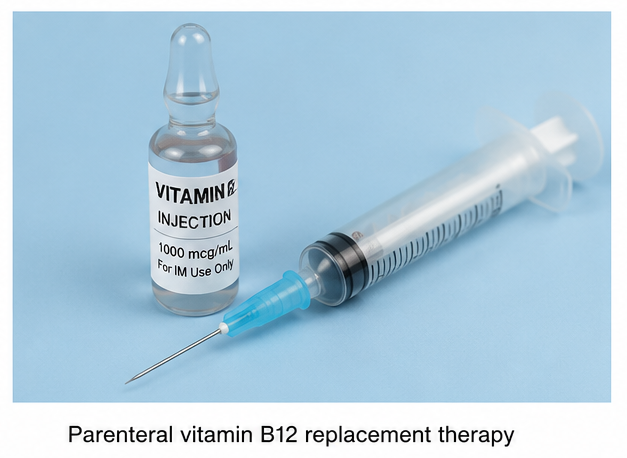
The patient was monitored with serial complete blood counts and biochemical investigations. Within the first few weeks, her fatigue and exercise tolerance improved. Glossitis resolved, and her appetite returned to normal.
Neurological symptoms improved more gradually. The intensity of paresthesia decreased, and balance progressively improved. Repeat laboratory testing demonstrated a significant rise in hemoglobin and resolution of macrocytosis, confirming a favorable hematological response.
The patient was counseled regarding the autoimmune nature of pernicious anemia and the need for long-term vitamin B12 replacement and regular follow-up.
Follow-up
One Month
• Fatigue and exertional dyspnea had significantly improved.
• Hemoglobin levels showed substantial improvement.
• Macrocytosis was progressively resolving.
• Glossitis had resolved.
• Paresthesia had decreased in intensity.
Three Months
• Energy levels and exercise tolerance had markedly improved.
• Hematological parameters had returned toward normal.
• Neurological symptoms continued to improve.
• Gait and balance were significantly better.
Six Months
• The patient remained clinically stable on maintenance vitamin B12 therapy.
• Hemoglobin and red blood cell indices remained within normal limits.
• Neurological symptoms were minimal and continued to improve.
• No new neurological deficits were observed.
Discussion
Pernicious anemia is an important cause of vitamin B12 deficiency resulting from autoimmune impairment of vitamin B12 absorption. It is primarily associated with autoimmune gastritis, leading to loss of gastric parietal cells and reduced intrinsic factor production. Antibodies against intrinsic factor and gastric parietal cells may support the diagnosis.
Vitamin B12 deficiency interferes with DNA synthesis, causing ineffective erythropoiesis and megaloblastic anemia. Peripheral blood findings may include macro-ovalocytes and hypersegmented neutrophils. However, clinical manifestations vary, and neurological complications may develop even when anemia is mild or absent.
Neurological manifestations are particularly important because delayed treatment may cause permanent damage. Patients may develop peripheral neuropathy, paresthesia, impaired vibration and proprioception, gait abnormalities, cognitive impairment, or subacute combined degeneration of the spinal cord.
Serum vitamin B12 measurement is an important initial investigation. Methylmalonic acid and homocysteine may be elevated in vitamin B12 deficiency and can help identify functional deficiency. Intrinsic factor antibody testing can support the diagnosis of pernicious anemia, although a negative result does not completely exclude the condition.
In the present case, severe macrocytic megaloblastic anemia, markedly reduced vitamin B12, elevated methylmalonic acid and homocysteine, neurological manifestations, and positive intrinsic factor antibodies established the diagnosis of pernicious anemia.
Parenteral vitamin B12 replacement is particularly appropriate in patients with severe deficiency, neurological involvement, or suspected malabsorption. Hematological recovery usually occurs more rapidly than neurological recovery. The extent of neurological improvement depends on the duration and severity of deficiency and may be incomplete when treatment is delayed.
Pernicious anemia is associated with chronic autoimmune gastritis and may increase the risk of gastric neoplasia, emphasizing the importance of appropriate long-term clinical follow-up.
Prognosis
The prognosis of pernicious anemia is generally favorable when diagnosed early and treated adequately. Hematological abnormalities usually resolve following appropriate vitamin B12 replacement. Neurological recovery may take longer and can be incomplete in patients with prolonged untreated deficiency.
Because the underlying autoimmune process persists, long-term vitamin B12 replacement is generally required. With appropriate treatment and monitoring, patients can maintain normal hematological function and prevent recurrence.
In this case, early recognition and prompt parenteral vitamin B12 therapy resulted in substantial hematological recovery and gradual improvement in neurological manifestations.
Conclusion
Pernicious anemia is an important and potentially underdiagnosed cause of severe vitamin B12 deficiency. It may present with macrocytic anemia, fatigue, glossitis, peripheral neuropathy, sensory disturbances, and gait abnormalities. Neurological manifestations can occur even without severe anemia and may become irreversible if treatment is delayed.
A combination of complete blood count, peripheral blood smear, serum vitamin B12, metabolic markers, and autoimmune antibody testing can help establish the diagnosis. Prompt vitamin B12 replacement is essential in patients with severe deficiency or neurological involvement.
This case highlights the importance of considering pernicious anemia in patients with unexplained macrocytic anemia and neurological symptoms. Early diagnosis, timely treatment, and long-term follow-up are essential to prevent recurrence and minimize permanent neurological complications.
References
-
Devalia V, Hamilton MS, Molloy AM; British Committee for Standards in Haematology. Guidelines for the diagnosis and treatment of cobalamin and folate disorders. Br J Haematol. 2014;166(4):496-513. https://pubmed.ncbi.nlm.nih.gov/24942828/
-
Green R, Allen LH, Bjørke-Monsen AL, et al. Vitamin B12 deficiency. Nat Rev Dis Primers. 2017;3:17040. https://pubmed.ncbi.nlm.nih.gov/28660828/
-
Stabler SP. Vitamin B12 deficiency. N Engl J Med. 2013;368(2):149-160. https://pubmed.ncbi.nlm.nih.gov/23301732/
-
Langan RC, Goodbred AJ. Vitamin B12 deficiency: recognition and management. Am Fam Physician. 2017;96(6):384-389. https://pubmed.ncbi.nlm.nih.gov/28925645/
-
Toh BH. Diagnosis and classification of autoimmune gastritis. Autoimmun Rev. 2014;13(4-5):459-462. https://pubmed.ncbi.nlm.nih.gov/24424115/
Read more such content on @ Hidoc Dr | Medical Learning App for Doctors
Recommended News For You
Recommended Articles For You
Featured News
Featured Articles
Featured Events
Featured KOL Videos
1.
Promising OS at 5 Years With Chemo-Free Combo in Urothelial Cancer
2.
Black Canadians Face Multiple Barriers to Blood Donation
3.
Stop Calling It Cancer; The Alcohol Paradox; Rural Patients Lose Ground in Screening
4.
Experts say oncology, primary care coordination necessary for best cancer patient outcomes
5.
Neural networks and label-free microscopy enable accurate detection of pancreatic tumors
1.
Machine Learning in Hematology: Boosting Diagnostic Precision and Speed in Medical Practice
2.
Advancing Cancer Care: Insights into Oncology Trials, Immunotherapy, and CAR-T Innovations
3.
Clinical Frameworks in Hematology for Better Care
4.
Empowering Lung Cancer Diagnosis Through the Synergy of Advanced Technologies and Artificial Intelligence
5.
The Benefits of Understanding Haptoglobin High: What You Need to Know
1.
Asian Symposium on Advancement in Hematology and Oncology (ASAHO)
2.
International Cancer Conference
3.
Asian Symposium on Advancement in Hematology and Oncology (ASAHO)
4.
Asian Symposium on Advancement in Hematology and Oncology
5.
Asian Symposium on Advancement in Hematology and Oncology
1.
An Eagles View - Evidence-based Discussion on Iron Deficiency Anemia- Panel Discussion
2.
Untangling The Best Treatment Approaches For ALK Positive Lung Cancer - Part II
3.
Newer Immunotherapies for Myeloma- A Comprehensive Overview- Part II
4.
Managing ALK Rearranged Non-Small Cell Lung Cancer with Lorlatinib - Part IV
5.
An Eagles View - Evidence-based discussion on Iron Deficiency Anemia- Important Points to Know

Address :
Hidoc Dr. Inc. | Delaware C Corp | 1309 Coffeen Ave. Suite 1200, Sheridan WY, 82801
Phone :
+1-415-463-3094
Email :
anishagadia@hidoc.co
© Copyright 2026 Hidoc Dr. Inc.
Terms & Conditions - LLP | Inc. | Privacy Policy - LLP | Inc. | Account Deactivation

To get started please enter your email ID
Welcome to Hidoc Dr.
Join to enhance your clinical skills and gain specialized in-depth medical knowledge